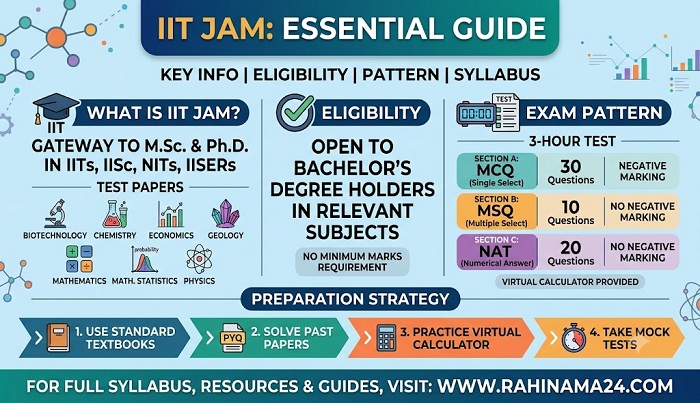
The Joint Admission Test for Masters (JAM) is a prestigious national-level entrance examination in India. It serves as the primary gateway for students aspiring to pursue postgraduate studies—specifically M.Sc., Joint M.Sc.–Ph.D., M.Sc.–Ph.D. Dual Degree, and other post-bachelor degree programmes—at the Indian Institutes of Technology (IITs), the Indian Institute of Science (IISc), and other participating National Institutes of Technology (NITs) and Centrally Funded Technical Institutes (CFTIs).
Exam Structure & Conduct
- Organizer: Conducted annually on a rotational basis by one of the IITs (e.g., IIT Bombay served as the organizing institute for the 2026 cycle).
- Mode: A Computer-Based Test (CBT) held in a single day.
- Frequency: Once a year, typically in February.
- Scope: The exam tests candidates on seven distinct subjects:
- Biotechnology (BT)
- Chemistry (CY)
- Economics (EN)
- Geology (GG)
- Mathematics (MA)
- Mathematical Statistics (MS)
- Physics (PH)
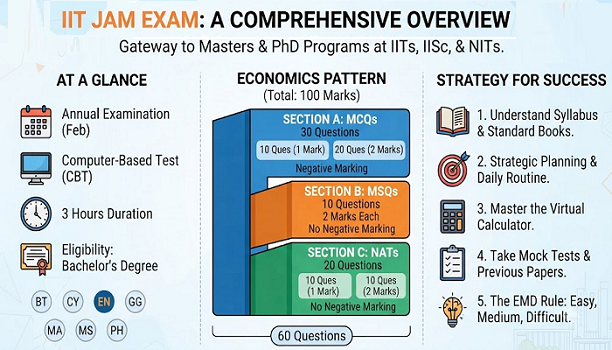
Exam Pattern (Total: 100 Marks | Duration: 3 Hours)
Question Paper Pattern:
- Section A – Multiple Choice Questions (MCQ):30 questions
- 10 questions carry 1 mark each.
- 20 questions carry 2 marks each.
- Negative marking is applicable.
- Section B – Multiple Select Questions (MSQ):10 questions
- Each question carries 2 marks.
- No negative marking.
- Section C – Numerical Answer Type (NAT):20 questions
- 10 questions carry 1 mark each.
- 10 questions carry 2 marks each.
- No negative marking.
Preparation Strategy & Tips
Success in IIT JAM requires a balance of conceptual clarity, regular practice, and strategic time management:
- Understand the Syllabus: Break down the syllabus into "strong" and "weak" topics. Prioritize the theoretical components first, followed by intensive numerical practice.
- Effective Planning: Maintain a consistent study routine. Focus on learning something new every day rather than cramming large volumes at once.
- Active Practice:
- Virtual Calculator: Since physical calculators are prohibited, master the official virtual calculator interface.
- Mock Tests & Previous Papers: These are the most reliable tools to gauge your speed, accuracy, and understanding of the exam's difficulty.
- The "EMD" Rule: When attempting the actual paper, follow the Easy-Medium-Difficult (EMD) approach:
- Spend the first 15 minutes scanning the entire paper.
- Complete all Easy questions first.
- Move to Medium questions.
- Reserve the most challenging (Difficult) questions for the end.
- Save at least 15 minutes at the end for revision.
- Stay Balanced: Keep your mental health in check—breathe, stay calm, and remember that it is a competitive exam that rewards consistent effort.
Note for Aspirants: Always refer to the official website of the current organizing institute (e.g., jam2026.iitb.ac.in for the 2026 cycle) for the most accurate information regarding dates, notifications, and official study resources. Avoid relying on outdated materials that may reflect previous exam patterns or removed subjects.
For more in-depth preparation tips and subject-specific strategies, check out our dedicated video on the Rahinama24 YouTube channel!