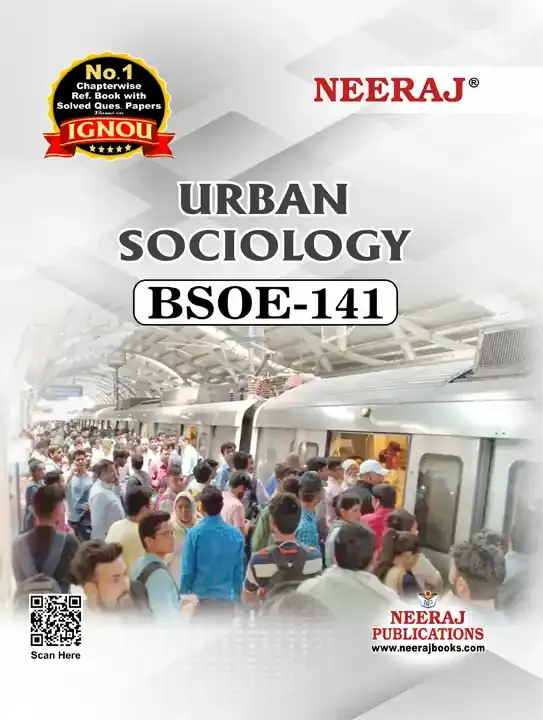
IGNOU BOOK | Introduction to Urban Sociology[English medium] MSOE-105 |
Out of Physical Stock
Standard delivery in 3–5 business days to .
Please enter a valid 6-digit Indian PIN code.
Fast Shipping
Tracked Pan-India Dispatch
100% Authentic
Verified Exam PYQs
Secure Payment
Razorpay / UPI / Cards
Instant PDF Access
Direct Online Download
Product Overview & Details
Urban Sociology is the branch of sociology that studies cities, urban life, urban communities, social relationships, institutions, and problems associated with urbanization. It examines how people live and interact in cities and how urban environments influence society.
1. Meaning of Urban Sociology
The word urban refers to cities and towns, while sociology is the systematic study of society and social relationships. Therefore, urban sociology can be understood as:
The systematic study of urban society, urban social relationships, institutions, communities, and processes of urban development and change.
Urban sociology studies not only the physical growth of cities but also changes in people's family life, occupations, culture, social relationships, class structure and lifestyles.
2. Emergence of Urban Sociology
Urban sociology developed mainly with the growth of modern cities during industrialization and urbanization. The Industrial Revolution led to the rapid expansion of cities because large numbers of people moved from rural areas to urban centres in search of employment.
Early sociologists became interested in questions such as:
- Why do people migrate to cities?
- How does city life affect family and community relationships?
- Why do poverty and inequality exist in cities?
- How are different social groups distributed across urban space?
- How does industrialization change traditional social relationships?
The Chicago School of Sociology played an important role in establishing urban sociology as a distinct field of study. Scholars such as Robert E. Park, Ernest W. Burgess and Louis Wirth studied urban communities, migration, neighbourhoods and urban lifestyles.
3. Major Areas of Study
Urban sociology covers a wide range of subjects:
a. Urbanization
It studies the process through which an increasing proportion of the population lives in towns and cities.
b. Urbanization and migration
It examines rural-to-urban migration, migrant communities and the social consequences of migration.
c. Urban communities
It studies neighbourhoods, slums, residential communities and relationships among urban residents.
d. Social stratification
Cities contain people belonging to different economic and social classes. Urban sociology studies inequality, poverty and social mobility.
e. Family and social relationships
Urban life can transform traditional family structures, kinship relations and patterns of social interaction.
f. Urban culture
Cities are often characterized by cultural diversity, new lifestyles, individualism, consumerism and changing values.
g. Urban problems
Urban sociology examines problems such as unemployment, housing shortages, overcrowding, slums, crime, pollution, traffic congestion and inadequate public services.
Book Specifications
| Author | Gaurav Sahni |
| Language | English |
| Publisher | Neeraj Publications |
| ISBN | 9788169520331 |
| Format | Paperback |
Customer Ratings & Reviews
Related Study Materials & Books
RecommendationsStudents preparing for this exam also purchased these resources