Book Store
Find reference notes, study guides, and dynamic curriculum files for book store preparation.
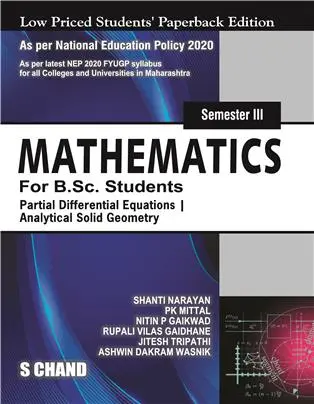
Mathematics for B.Sc. Students | Partial Differential Equations & Analytical Solid Geometry | Semester III | NEP 2020 Maharashtra | B.Sc. Mathematics Textbook
Mathematics for B.Sc. Students: Partial Differential Equations | Analytical Solid Geometry is an academic textbook designed for B.Sc. Semester III students following the NEP 2020 curriculum in Maharashtra.The book focuses on two important areas of undergraduate mathematics: Partial Differential Equations and Analytical Solid Geometry. It is intended to support students in understanding key mathematical concepts and developing the problem-solving skills required for their semester studies.With its subject-focused coverage, this book can be used for regular classroom study, concept revision, practice, and examination preparation. It is a useful academic resource for B.Sc. students looking for mathematics study material aligned with their Semester III coursework.Key FeaturesDesigned for B.Sc. Semester III studentsBased on the NEP 2020 Maharashtra curriculumCovers Partial Differential EquationsCovers Analytical Solid GeometryUseful for concept learning and academic revisionSupports mathematical problem-solving practiceSuitable for semester examination preparationDesigned for undergraduate mathematics studiesIdeal ForThis textbook is suitable for students searching for B.Sc. Mathematics books, Semester 3 Mathematics textbooks, Partial Differential Equations books, Analytical Solid Geometry books, Maharashtra NEP 2020 books, B.Sc. study material, and undergraduate mathematics textbooks.Book Title: Mathematics for B.Sc. Students: Partial Differential Equations | Analytical Solid GeometrySemester: IIICurriculum: NEP 2020 – MaharashtraSubjects: Partial Differential Equations | Analytical Solid GeometryCategory: B.Sc. Mathematics | Academic Textbook | Semester III
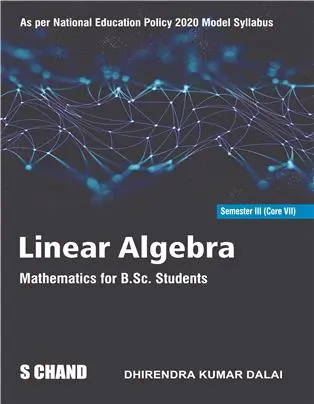
Linear Algebra: Semester III: Core VIII (NEP Odisha)
This is a comprehensive and rigorously structured textbook designed as per the syllabi of some major Universities and technical institutions. The book provides a clear and systematic exposition of fundamental concepts such as Vector Spaces, Linear Transformations, Matrices, Determinants, Eigenvalues and Inner Product Spaces.The text emphasizes both theoretical understanding and problem-solving skills, presenting detailed proofs alongside a large number of worked examples to help students grasp abstract concepts with ease. Advanced topics such as Diagonalization, Canonical Forms, Spectral Theory and Quadratic Forms are introduced in a structured manner, highlighting their applications across various fields of science and engineering.With its student-friendly approach and extensive practice material, this book serves as an ideal companion for classroom learning, self-study, and competitive examinations, enabling learners to build a strong foundation in linear algebra.Concept-oriented presentation with rigorous proofs for a strong theoretical foundation A large number of worked examples in each chapter for step-by-step understanding and carefully selected problems to enhance analytical and problem-solving skills Graded exercises and review problems for effective practice and revision Appendices on matrices and determinants to support foundational learning
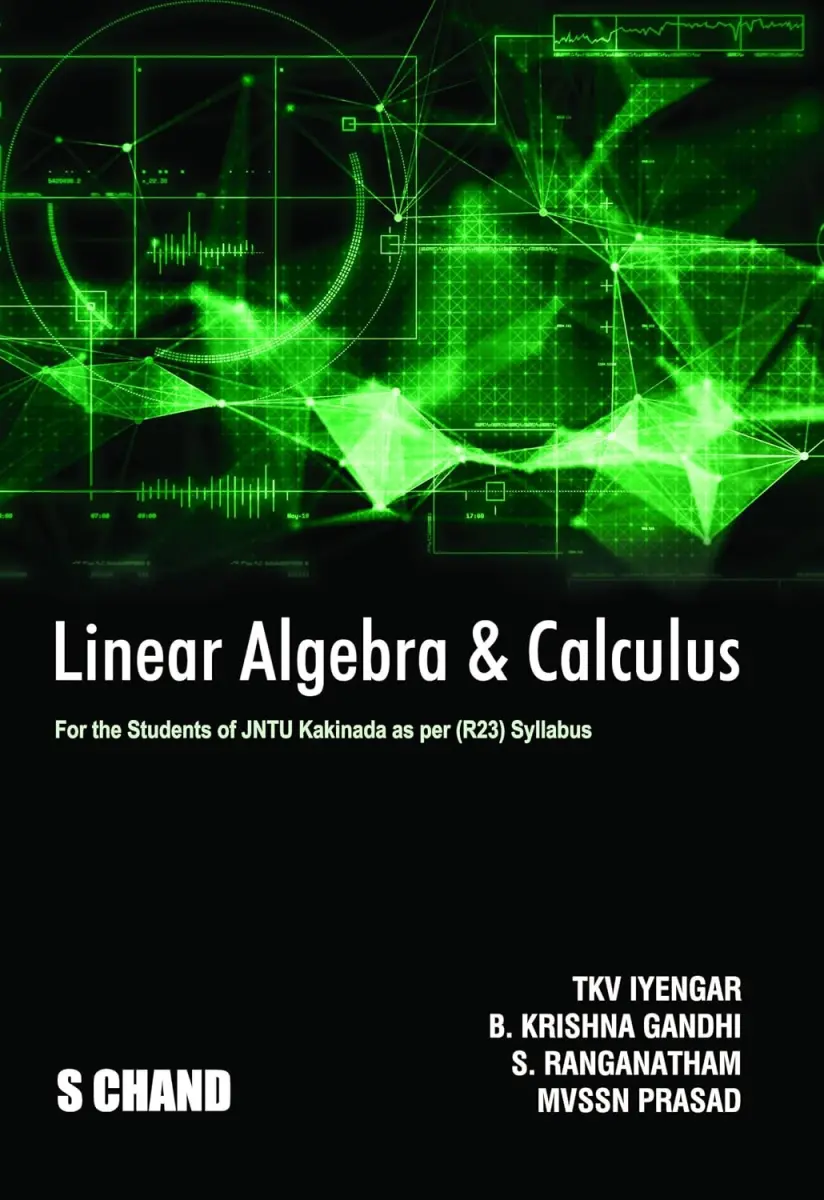
Linear Algebra & Calculus For the Students of JNTU Kakinada as per (R23) Syllabus
The book Linear Algebra & Calculus has been written strictly as per the latest syllabus (R-23) prescribed by Jawaharlal Nehru Technological University, Kakinada, for all branches of B.Tech. First Year students.The book provides a clear, systematic, and application-oriented treatment of both Linear Algebra and Calculus, ensuring students gain a strong foundation in mathematical concepts essential for engineering problem-solving.Complete coverage of Matrices, Eigenvalues, Eigenvectors and Quadratic Forms, along with practical methods like Gauss-Jordan, Jacobi, and Gauss-Seidel iterations.Detailed exposition of Mean Value Theorems, Partial Differentiation, Multivariable Calculus and Multiple Integrals with geometrical interpretation and engineering relevance.Step-by-step solved examples to build confidence and clarity.Objective type questions, university examination papers and previous GATE questions included for practice and assessment.Applications of calculus and matrix methods in real-world engineering scenarios.Authored by renowned academicians with decades of teaching and research experience, this book blends rigorous mathematical theory with a student-friendly presentation style. It serves not only as a core textbook for classroom learning but also as a valuable resource for examinations and competitive tests.With its structured approach and abundant practice material, the book equips engineering students with the analytical tools required to excel in their academic and professional pursuits.
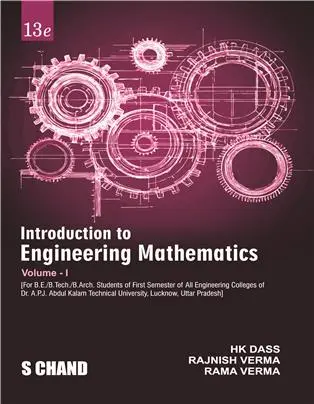
Introduction to Engineering Mathematics Volume 1 | 13th Edition | Engineering Mathematics Textbook | Mathematical Concepts, Methods & Applications | Study & Exam Preparation
Introduction to Engineering Mathematics Volume 1 is a study-oriented textbook designed to help students build a strong foundation in the mathematical concepts and methods used in engineering studies. The 13th Edition provides a structured resource for learning, practice, and revision.The book is suitable for students beginning their engineering mathematics coursework and can support understanding of mathematical techniques used across engineering and technical subjects. It can be used for classroom study, self-learning, problem-solving practice, and semester examination preparation.Key Features13th EditionVolume 1 of Introduction to Engineering MathematicsDesigned for engineering mathematics studyCovers foundational mathematical concepts and methodsSupports mathematical problem-solving and applicationUseful for classroom learning and self-studySuitable for revision and semester exam preparationHelpful as a reference for engineering studentsIdeal ForThis book is suitable for students searching for Engineering Mathematics textbooks, Engineering Maths Volume 1, first-year engineering mathematics books, mathematics for engineering students, technical mathematics textbooks, and engineering exam preparation books.Book Title: Introduction to Engineering Mathematics Volume 1Edition: 13th EditionSubject: Engineering MathematicsVolume: 1Category: Engineering | Mathematics | Textbook | Study & Exam Preparation
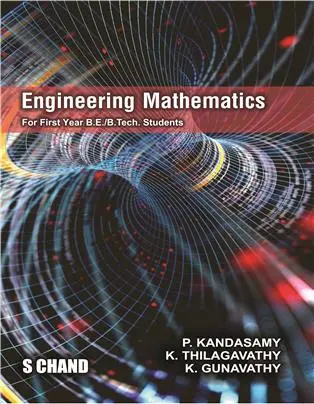
Engineering Mathematics for First Year B.E./B.Tech. Students | For Kongu Engineering College | Engineering Mathematics Textbook | Study & Exam Preparation
Engineering Mathematics for First Year B.E./B.Tech. Students is an academic textbook designed for undergraduate engineering students, with a focus on the requirements of students at Kongu Engineering College.The book provides a structured resource for studying mathematics as part of the first-year engineering curriculum. It can support students in understanding mathematical concepts, working through problems, revising important topics, and preparing for university and semester examinations.Designed as a study and reference resource, this book is useful for students who want to strengthen their mathematical foundation during the first year of B.E./B.Tech. engineering studies.Key FeaturesDesigned for First Year B.E./B.Tech. studentsSpecifically intended for students of Kongu Engineering CollegeCovers Engineering Mathematics for undergraduate engineering studiesUseful for concept learning and problem-solving practiceSupports semester examination preparation and revisionSuitable for classroom study and self-studyHelpful as an academic reference for engineering studentsIdeal ForThis book is suitable for students searching for Engineering Mathematics books, B.E. Mathematics textbooks, B.Tech. Mathematics books, first-year engineering books, Kongu Engineering College study material, engineering mathematics reference books, and semester exam preparation books.Book Title: Engineering Mathematics for First Year B.E./B.Tech. StudentsTarget: First Year B.E./B.Tech.Institution: Kongu Engineering CollegeSubject: Engineering MathematicsCategory: Engineering | Mathematics | B.E. | B.Tech. | Academic Textbook
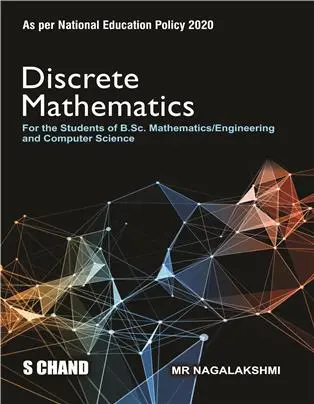
Discrete Mathematics, Semester II [NEP Jharkhand]
This comprehensive textbook has been designed to meet the needs of B.Sc. second semester students of Mathematics as well as honours and post graduate degree students of Mathematics as per Common Minimum Syllabus prescribed for Ranchi University and other Universities and Colleges under the recommended National Education Policy 2020 in Jharkhand. The book is also a helpful resource for Engineering, Computer Science, BCA and MCA students. The book provides a clear and structured approach to foundational topics in Discrete Mathematics. Key topics include Partially Ordered Sets (Posets), Lattices and Graph Theory, explained through well-illustrated examples, figures and solved problems. With extensive practice exercises and a dedicated section for university exam questions, this book supports students in mastering concepts and preparing effectively for examinations.Comprehensive coverage of NEP and Skill Enhancement Course (SEC) syllabus of Ranchi UniversityStep-by-step explanations with illustrative diagramsRich collection of examples, exercises and university exam questionsAlso helpful for students of B.Sc., BCA, MCA, Engineering and IT courses
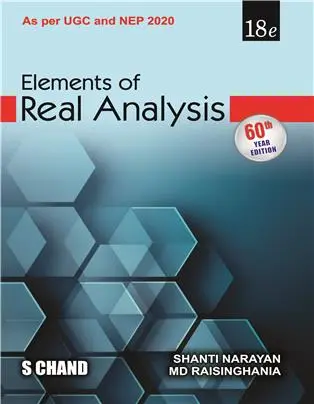
Elements of Real Analysis, 18e
Elements of Real Analysis is a classic and convincing text that offers a rigorous, student-friendly introduction to the foundations of Real Analysis. Beginning from the basic concepts of sets, functions and the real number system, the book develops the subject systematically through sequences, series, limits, continuity, differentiation, Riemann and Riemann-Stieltjes integration, improper integrals, uniform convergence, power series, Fourier series and advanced topics such as functions of bounded variation.In this edition, the book incorporates improved explanations, new theorems, additional solved examples and updated problems drawn from recent examinations. The authors present concepts with clarity and logical precision, making the text ideal for undergraduate and postgraduate students, as well as aspirants of competitive examinations like GATE, CSIR-UGC NET and IAS.• Covers the entire syllabus for B.A./B.Sc., B.Sc. (Hons.), M.A./M.Sc., and engineering mathematics courses.• More than 2,000 solved examples with step-by-step explanations for conceptual clarity.• Extensive chapter coverage, including: Topology of the real line, countability, sequences and series Limits, continuity, differentiability and mean value theorems Riemann and Riemann-Stieltjes integrals Improper integrals, uniform convergence and power series Differentiation under the integral sign and Beta-Gamma functions Chapter on Functions of Bounded Variation• Latest solved question papers from major universities, GATE (2005-2025), CSIR-UGC NET (2011-2025) and IAS examinations.• Modern notation, intuitive explanations, and logical development make the subject accessible without compromising rigour.• Rich pedagogical aids including illustrations, remarks, counterexamples, and self-practice exercises.• Glossary of Symbols, Index and lists of important results for quick reference.Clear, comprehensive, and reliable, the book remains an indispensable resource for mastering the principles of Real Analysis and building a strong mathematical foundation for advanced study and research.
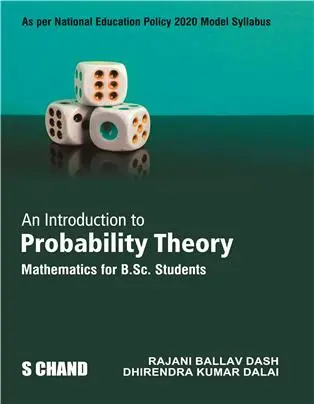
An Introduction to Probability Theory, Sem III, Core V (NEP Odisha)
The book An Introduction to Probability Theory is a comprehensive and well-structured textbook designed to needs of B.Sc. Third Semester (Core V) students of Mathematics as per the Common Minimum Syllabus prescribed for Odisha University and other Universities and Colleges under the recommended National Education Policy 2020 in Odisha. The book also meets the requirements of the students of Computer Science and Engineering of different Universities. The book offers a clear and systematic exposition of fundamental concepts in probability, reinforced with illustrative examples and a wide range of exercises for practice.The text begins with the foundational notions of Sample Spaces, Events and conditional probabilities, gradually progressing to Real Random Variables, Probability Distributions and Joint Probability Distributions. Special focus is given to essential topics such as Bayes' Theorem, moment-generating functions and limit theorems. The final chapters introduce students to more advanced areas, including Markov Chains and their applications.This book serves as an essential resource for students aiming to build a strong base in probability theory and develop the analytical skills needed for further study in statistics, data science, and applied mathematics.Thorough coverage of probability theory aligned with the B.Sc. curriculum.Step-by-step explanations of concepts with illustrative examples.A large number of exercises at the end of each chapter for practice and assessment.Dedicated chapters on joint probability distributions and Markov Chains.Includes an appendix for additional reference and quick review.
A Textbook of Mathematical Physics – III | Advanced Mathematical Physics Textbook for Physics Students
A Textbook of Mathematical Physics – III is an advanced academic textbook designed to help physics students develop a strong understanding of the mathematical methods and techniques required for higher-level physics studies. The book focuses on the mathematical foundations that support the analysis, formulation, and solution of complex problems encountered across various areas of theoretical and mathematical physics.The text is particularly useful for undergraduate and postgraduate students of Physics, as well as learners preparing for university examinations and competitive examinations. It provides a systematic approach to important mathematical concepts, helping students connect mathematical theory with its applications in physical sciences.The book covers advanced mathematical tools and methods relevant to physics, with emphasis on understanding concepts, mathematical formulations, problem-solving techniques, and their practical applications. Topics are presented in a structured manner to make difficult mathematical ideas easier to study and revise. The content can help students strengthen their analytical abilities and develop confidence in solving numerical and theoretical problems.A Textbook of Mathematical Physics – III is suitable for classroom learning, self-study, examination preparation, assignments, and revision. Its academic approach makes it a useful reference for students who want to improve their command of mathematical techniques used in physics.Whether used as part of a university curriculum or as a supplementary reference, this textbook provides valuable support for understanding the mathematical language of modern physics. It is an appropriate resource for students looking to build a deeper foundation in mathematical physics and apply mathematical methods effectively to advanced physical concepts.Overall, A Textbook of Mathematical Physics – III serves as a comprehensive study companion for physics students seeking to strengthen their mathematical skills, improve problem-solving abilities, and gain a clearer understanding of advanced mathematical techniques used throughout physics.Strengthen your understanding of the mathematical methods used in advanced physics with A Textbook of Mathematical Physics – III.A Textbook of Mathematical Physics – III is an academic resource designed for students studying mathematical methods and their applications in physics. The book focuses on developing the mathematical foundation required to understand, formulate, and solve advanced problems in physics.With a structured approach to mathematical concepts and their applications, this textbook can support concept building, problem-solving, classroom learning, and examination preparation.Key FeaturesMathematical Physics – III: Designed for advanced study of mathematical methods used in physics.Concept-Oriented Approach: Helps students develop a clear understanding of mathematical techniques.Physics Applications: Connects mathematical methods with problems and applications in physics.Problem-Solving Focus: Useful for developing analytical and mathematical problem-solving skills.Structured Academic Resource: Suitable for systematic study and revision.Exam Preparation: Helpful for university-level examinations, assignments, and revision.Reference for Physics Students: Supports students pursuing undergraduate or related physics courses.Topics May IncludeDepending on the syllabus and edition, the textbook may cover areas such as:Mathematical methods and techniquesDifferential equationsPartial differential equationsVector analysisSpecial functionsComplex variablesFourier methodsMathematical techniques used in physicsPerfect ForPhysics undergraduate studentsMathematical Physics studentsB.Sc. Physics learnersStudents preparing for university examinationsStudents studying advanced mathematical methodsTeachers and educatorsAcademic reference and self-studyWhy Choose This Book?Mathematical methods form an essential foundation for understanding many areas of physics. A Textbook of Mathematical Physics – III helps students develop the mathematical tools and analytical skills required to approach physics problems systematically.Build stronger mathematical foundations for physics and improve your problem-solving skills with this comprehensive academic textbook.Note: Exact topics, syllabus coverage, and chapter structure may vary by publisher and edition. Please check the edition and product specifications before purchase.
A Textbook of Mathematical Physics – I
This textbook has been designed as per the Common Minimum Syllabus prescribed for Odisha University and other Universities and Colleges under the recommended National Education Policy 2020 in Odisha and other states. Mathematical Physics-I is a comprehensive textbook tailored for undergraduate students. The book provides a solid mathematical foundation essential for understanding and solving physical problems. It systematically introduces the tools of calculus, vector analysis, differential equations, and coordinate systems, with a clear focus on their application to real-world physics.Divided into two broad units, the book covers essential concepts of Single and Multivariable Calculus, Taylor and Binomial Expansions and the Theory of Ordinary Differential Equations in Unit I. Unit II offers an extensive treatment of Vector Algebra and Calculus, Scalar and Vector Fields, Integral Theorems, Coordinate Transformations and Applications to Physical Motion.With a balance between theory and application, this book is ideal for students preparing for university exams and developing problem-solving skills in mathematical physics.Comprehensive coverage of core mathematical tools used in physicsStep-by-step explanations and derivations for better conceptual clarityInclusion of Taylor Series, Binomial Theorem and Differential Equations with physical applicationsExtensive chapters on Vector Algebra and Vector Calculus including Gauss's, Stokes' and Green's TheoremsDetailed discussion on coordinate systems: Cartesian, Cylindrical and SphericalApplications to real-world physical problems such as thermodynamics and motion in two dimensionsAppendices on Determinants and Matrices for algebraic foundationsPedagogically rich content with illustrations and structured topic-wise progression
A Textbook of B.Sc. Mathematics: Solid Geometry, (First Year, First Semester) (Andhra Pradesh)
A Textbook of BSc Mathematics: Solid Geometry is thoughtfully designed to meet the academic needs of first-year undergraduate students pursuing Mathematics in universities across Andhra Pradesh. It provides a structured and comprehensive approach to studying differential equations, starting with foundational concepts and progressing to advanced topics.The book is divided into five units, each carefully curated to build conceptual clarity and problem-solving skills. Unit 1 introduces "The Plane" (including the equation of a plane in terms of its intercepts and the length of the perpendicular from a point to a plane). Unit 2 explores "The Line" (including equation of a line in various forms, condition for two lines to be coplanar, the shortest distance between two lines and length and equation of the line of shortest distance). Units 3 and 4 delve into "The Sphere" (including equation of a sphere through four points, intersection of two spheres, tangent plane and plane of contact and angle of intersection of two spheres). Unit 5 enriches the learning experience through Co-Curricular Activities, including quizzes, problem-solving sessions and real-life applications of differential equations. A detailed key to "A Textbook of B.Sc. Mathematics: Solid Geometry" is also provided for the convenience of the students.Conceptual clarity with more than 150 solved examples.Practice exercises in excess of 200 for self-assessment.Real-world applications to bridge theory and practice.More than 125 Co-curricular activities such as Quizzes, Problems for "Problems Solving Session" to Solid Geometry and its Applications.
A Textbook of B.Sc. Mathematics: Differential Equations, (First Year, First Semester) (Telangana State)
A Textbook of B.Sc. Mathematics: Differential Equations is carefully designed as per new Common Core Syllabus 2025-26 based on CBCS for B. Sc. First Year First Semester Students of the Universities in Telangana State.The book systematically introduces the subject, beginning with the Basics of First-Order Differential Equations, progressing through equations of First Order but not of First Degree and advancing to Higher-Order Linear Differential Equations with Constant and Non-Constant coefficients. Each chapter is presented in a lucid style with step-by-step explanations, making it accessible to learners of all levels.In addition to comprehensive theory, the textbook offers a balanced blend of solved examples, exercise problems and objective-type questions to reinforce learning and enhance examination preparedness.The book provides a solid grounding in the fundamentals and applications of differential equations and also useful for those preparing for competitive and higher studies examinations.Written strictly as per the latest Telangana State B.Sc. Mathematics syllabus.Covers all major topics of Differential Equations in a systematic and student-friendly manner.Step-by-step solutions provided for better understanding of concepts.Includes solved examples, unsolved exercises, and objective-type questions for practice and self-assessment.Provides a balance of theory and applications, connecting abstract concepts to practical problems.Contains a key to objective-type questions for quick reference and exam readiness.Suitable both as a textbook for students and a reference guide for aspirants of competitive exams.
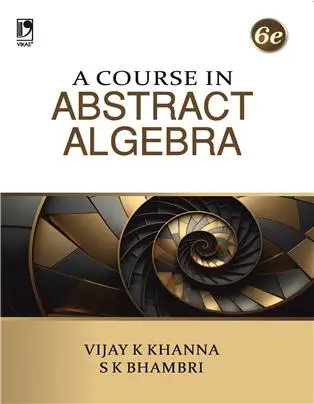
A Course in Abstract Algebra (6TH Edition)
The book has been designed for undergraduate and postgraduate students of Mathematics and it can also be used by those preparing for various competitive examinations. The text starts with an introduction to results from Sets and Number theory. It then goes on to cover Groups, Rings, Fields and Linear Algebra. Of late, Number theory has been becoming a part of Algebra syllabus and thus sufficient relevant material on the subject has been covered especially in the present edition. This includes besides others the phi, greatest integer and möbius functions, primitive roots, Euler and Wilson theorems. The topics under Groups include subgroups, normal subgroups, finitely generated abelian groups, group actions, solvable and nilpotent groups. The course in ring theory covers ideals, embedding of rings, Euclidean domains, PIDs, UFDs, polynomial rings, Noetherian rings. Topics in Fields include algebraic extensions, normal and separable extensions, splitting fields, algebraically closed fields, Galois extensions and construction by ruler and compass. The portion on linear algebra deals with Vector spaces, linear transformations, eigen spaces, diagonalizable operators, inner product spaces etc. The theory has been strongly supported by numerous examples and worked out problems. There is also plenty of scope for the readers to try and solve problems on their own.New In the Sixth EditionThe first chapter has been recast as "Sets and Number Theory".Four new sections have been included - Wilson's Theorem, Euler's phi Function, The Greatest Integer Function, and Primitive RootsNewer examples have been included at places.
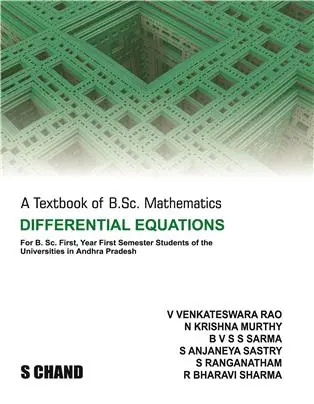
A Textbook of B.Sc. Mathematics: Differential Equations (First Year, First Semester) (Andhra Pradesh)
A Textbook of BSc Mathematics: Differential Equations is thoughtfully designed to meet the academic needs of first-year undergraduate students pursuing Mathematics in universities across Andhra Pradesh. It provides a structured and comprehensive approach to studying differential equations, starting with foundational concepts and progressing to advanced topics.The book is divided into six units, each carefully curated to build conceptual clarity and problem-solving skills. Unit 1 introduces Exact, Linear, and Bernoulli Differential Equations. Unit 2 explores Differential Equations of First Order but not of First Degree, while Unit 3 delves into Higher Order Linear Differential Equations. Units 4 and 5 focus on Second-Order Linear Differential Equations -Part I and II. Unit 6 enriches the learning experience through Co-Curricular Activities, including quizzes, problem-solving sessions and real-life applications of differential equations. A detailed key to "A Textbook of B.Sc. Mathematics: Differential Equations" is also provided for the convenience of the students.Conceptual clarity with more than 150 solved examples.Practice exercises in excess of more than 200 for self-assessment.Real-world applications to bridge theory and practice.More than 125 Co-curricular activities such as Quizzes, Problems for "Problems Solving Session" and "Applications of Differential Equations in Real-life Problems" to foster analytical thinking.
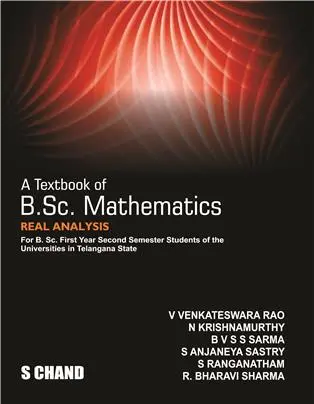
A Textbook of B.Sc. Mathematics (Real Analysis), Semester II (Telangana State)
The book has been carefully developed as per New Common Core Syllabus 2025-26 based on CBCS for B. Sc. First Year: Second Semester Students of the Universities in Telangana State. It offers a clear, rigorous, and student-friendly introduction to the foundational concepts of Real Analysis, forming a strong base for advanced mathematical studies. The text begins with the structure and properties of real numbers, including field axioms, order axioms, completeness and the supremum property. It then systematically develops the theory of Sequences, Sub sequences, Monotonic and Cauchy Sequences, followed by a detailed treatment of Infinite Series and Tests of convergence. The chapters on functions of a single variable present Limits, Continuity, Differentiability and Mean Value Theorems with logical proofs and illustrative examples. The book concludes with a comprehensive exposition of the Riemann Integral, covering integrability conditions, properties of integrals and the Fundamental Theorem of Calculus. Special emphasis is placed on conceptual clarity, step-by-step proofs, and problem-solving techniques. All chapters are supported with well-graded exercises and detailed solutions, making the book a dependable resource for examination preparation and self-study. Fully aligned with Telangana State Universities Common Core Curriculum (CBCS), 2025-26Systematic coverage of Real Numbers, Sequences, Series, Continuity, Differentiation and Riemann IntegrationClear exposition of completeness axiom, supremum-infimum concepts and Dedekind cutsRigorous yet accessible presentation of theorems with proofsLogical progression from basic concepts to advanced analytical resultsExtensive coverage of Mean Value Theorems and their applicationsWell-structured chapters with definitions, theorems, illustrations and remarksLarge collection of solved and unsolved problems for effective practiceDetailed solutions provided at the end, aiding independent learning Suitable for classroom teaching, examination preparation and a reference guide for aspirants of competitive exams
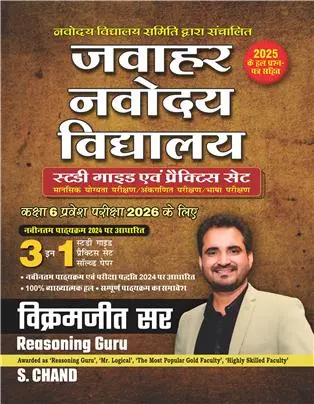
Jawahar Navodaya Vidyalaya Class 6 Pravesh Pariksha 2026 Ke Liye | (3 in 1) Study Guide + Practice Set + Solved Papers (2025)
जवाहर नवोदय विद्यालय स्टडी गाइड एवं प्रैक्टिस सेट एक व्यापक अध्ययन सामग्री है, जिसे कक्षा 6 प्रवेश परीक्षा 2026 के लिए तैयार किया गया है, जिसे नवोदय विद्यालय समिति द्वारा आयोजित किया जाता है। यह पुस्तक 2024 की नवीनतम परीक्षा पैटर्न पर आधारित है और इसमें तीनों मुख्य भागों — मानसिक योग्यता परीक्षण, अंकगणित परीक्षण, और भाषा परीक्षण — के लिए विस्तृत अध्ययन गाइड तथा अभ्यास सेट शामिल हैं। साथ ही, इसमें 2025 की हल प्रश्न-पत्र भी दी गई है, जो अभ्यर्थियों को नवीनतम प्रश्न प्रवृत्तियों की स्पष्ट समझ प्रदान करती है। विषय विशेषज्ञों द्वारा तैयार की गई यह पुस्तक लक्षित और परिणामोन्मुखी तैयारी के लिए एक अत्यंत उपयोगी संसाधन है।प्रवेश परीक्षा के अनुसार विषयों का वर्गीकरण करके मानसिक क्षमता, अंकगणित और भाषा अनुभाग को सरल एवं समझने योग्य ढंग से प्रस्तुत किया गया है।2024 के नवीनतम पैटर्न पर आधारित नई और संभावित प्रश्न-शैली को शामिल किया गया है।पूर्ववर्ती वर्षों के प्रश्न-पत्रों का विश्लेषण कर संभावित प्रश्नों को हल सहित दिया गया है।पुस्तक में आवश्यक ट्रिक्स और टिप्स शामिल हैं, जो छात्रों को कठिन प्रश्नों को भी आसानी से हल करने में मदद करेंगे।
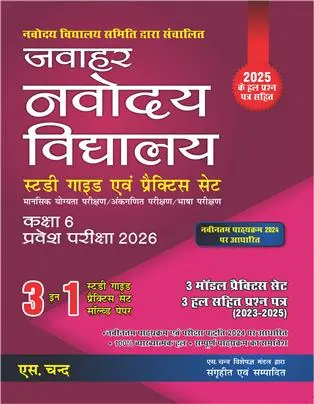
Jawahar Navodaya Vidyalaya Class 6 Pravesh Pariksha 2026 | (3 in 1) Study Guide and Practice Sets | In Hindi
प्रस्तुत पुस्तक 3-इन-1 स्टडी गाइड, नवीनतम ट्रेंड्स और पैटर्न पर आधारित है। यह पुस्तक जवाहर नवोदय विद्यालय प्रवेश परीक्षा के छात्रों की तैयारी के लिए एक बेहतरीन विकल्प है। "स्टडी गाइड" में सम्पूर्ण पाठ्यक्रम को 3 खंडों मानसिक योग्यता परीक्षण, अंकगणित परीक्षण और भाषा परीक्षण में विभाजित किया गया है। प्रत्येक अध्याय में दिए गए विस्तृत हल, विद्यार्थियों की विषय पर पकड़ को मजबूत बनायेंगे। इस पुस्तक में 3 अभ्यास सेट एवं विगत 2 वर्षों के हल सहित प्रश्नपत्र शामिल किये गये हैं। ये प्रैक्टिस सेट विद्यार्थियों को अच्छे अंक प्राप्त करने में सहायक सिद्ध होंगे।पुस्तक की विशेषताएँ 1. जवाहर नवोदय विद्यालय प्रवेश परीक्षा के बारे में पूरी जानकारी दी गई है। 2. प्रवेश परीक्षा में पूछे जाने वाले विषयों की आपके मानसिक स्तर के अनुरूप समझाया गया है। 3. अभ्यास हेतु प्रश्नों का अपार भण्डार दिया गया है तथा सभी प्रश्नों के व्याख्या तथा आकृतियों के माध्यम से समझाया गया है। 4. वर्ष 2024 से अंकगणित विषय में कुछ नये अध्यायों को जोड़ा गया है, जो इस पुस्तक में दिये गये हैं। 5. नये पाठ्यक्रम के आधार पर आदर्श प्रश्न-पत्र दिए गये हैं। वर्ष 2019 से पहले परीक्षा में 100 प्रश्न पूछे जाते थे, परन्तु वर्तमान में 80 प्रश्न ही पूछे जाते हैं। 6. विगत वर्षों के प्रश्न-पत्र हल सहित दिये गये हैं।
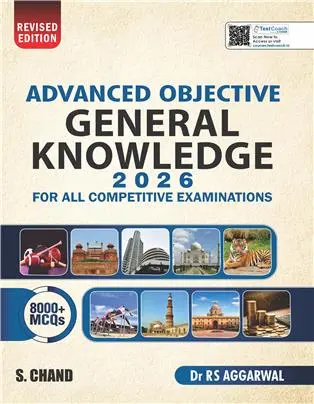
Advanced Objective General Knowledge 2026 for All Competitive Examinations
This book is a perennial favourite among competitive exam aspirants. Renowned for its comprehensive coverage, enduring popularity, and regular updates to match current trends, the book offers an expansive question bank, including original questions from diverse exams. With its structured approach, featuring segregated questions and specialized Model Sets, it ensures a focused and organized study experience for aspirants across various subjects. This book is also updated to fit the current examination trends. Original questions (based on memory) from exams like SSC, Banking, Railways, UPSC and other state PSC exams, Teacher, Police and other state exams and several others have been added in different sections of the book—General Science, History, Indian Polity, Economics, Geography, and General Awareness.1. Comprehensive coverage of original questions from various competitive exams.2. Enduring popularity despite strong competition.3. Updated to align with current examination patterns and trends.4. Expanded question variety with thousands of new MCQs.5. Structured approach with segregated questions and specially designed Model Sets for focused preparation.