Categories
- All Products
-
Book Store
- Academic Books
- State PSC Books
- GATE & PSU Books
- CSIR-NET
- IIT-JAM Books
- UGC-NET JRF Books
- SSC, Banking, Railway & Other Government Exams
- Engineering and Technical Exams
- NCERT & Other Reference Books
- UPSC Books
- Learn Beyond Academics
- IIT-JEE | NEET Foundation (Class 9 & 10)
- IIT-JEE | NEET Foundation (Class 11 & 12)
- Judiciary Books
- Common Books for almost Every Competitive Exam
- Other Competitive Exam Books
- Coaching Notes
- Handwritten Notes
-
Test Series & PYQ Books
- For UPSC Solved Papers & PYQs Books
- For GATE & PSU Solved Papers & PYQs Books
- Class 9 to 12 Solved Papers & PYQs Books
- For IITJEE |NEET
- State-PSC
- Engineering and Technical Exams Solved Paper & PYQs
-
SSC, Banking & Other Government Exams Solved Papers & PYQs Books
- SSC (CGL, CHSL, MTS, CPO, GD) Solved Papers & PYQs Books
- Banking (IBPS PO, Clerk, SBI PO, RBI) Solved Papers & PYQ Books
- Railway (NTPC, Group D, ALP, Technician, Other RRB Exams ) Solved Paper & PYQs
- Defence Exams (NDA, CDS, AFCAT, CAPF) Solved Papers & PYQ Books
- Teaching Exam (CTET, UPTET, DSSSB, KVS, NVS, TGT, PGT, EMRS)Solved Papers & PYQ Books
- UGC NET JRF Solved Papers & PYQ Books
- CSIR NET GATE Solved Papers & PYQ Books
- Other Competitive Exam Solved Papers & PYQ Books
- E-Books
- Inspirational Book
- Magazines
- Stationery
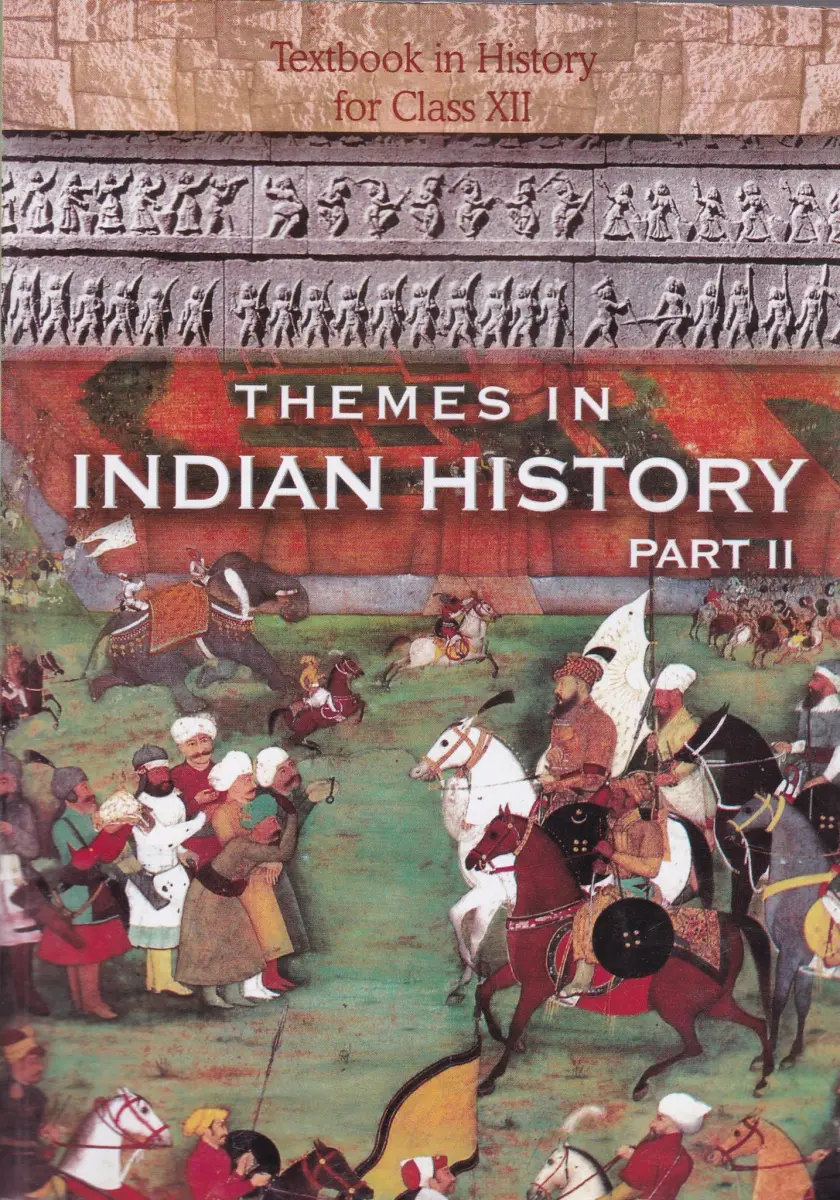
NCERT Themes In Indian History Part II for Class 12 - latest edition as per NCERT/CBSE
Themes in Indian History Part II is the second volume of the three-volume NCERT Class XII History series. It focuses mainly on medieval and early-modern Indian history, using travellers' accounts, devotional literature, architecture, administrative records and other historical sources to help students understand how historians reconstruct the past.For CBSE 2026–27, Part II covers Themes 5–8. The official CBSE syllabus places these themes within the Class XII History curriculum.
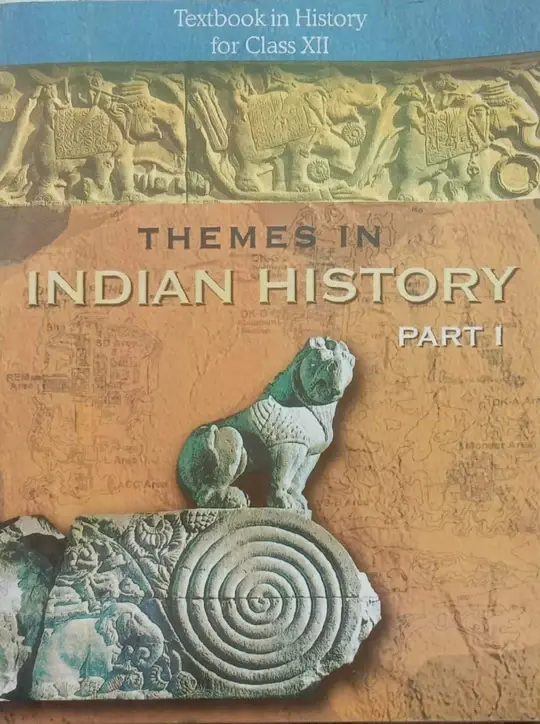
NCERT Themes In Indian History Part I for Class 12 - latest edition as per NCERT/CBSE
I checked the current NCERT textbook listing and the CBSE 2026–27 History curriculum. The current NCERT online textbook is Themes in Indian History–I, and the NCERT publication code is 12093. The official NCERT publication list gives the current listed price as ₹105.
NCERT Information Practice for class 12- latest edition as per NCERT/CBSE
The NCERT Class XII Informatics Practices textbook is designed around data handling, data analysis, SQL, data visualisation, computer networks, Internet/web technologies and societal impacts of technology.NCERT describes the book as focusing on fundamental concepts of handling data and introducing students to emerging areas of information and communication technology. It is intended to develop practical skills relevant to areas such as data science and related fields. The current book has 7 chapters, including a project-based-learning chapter.
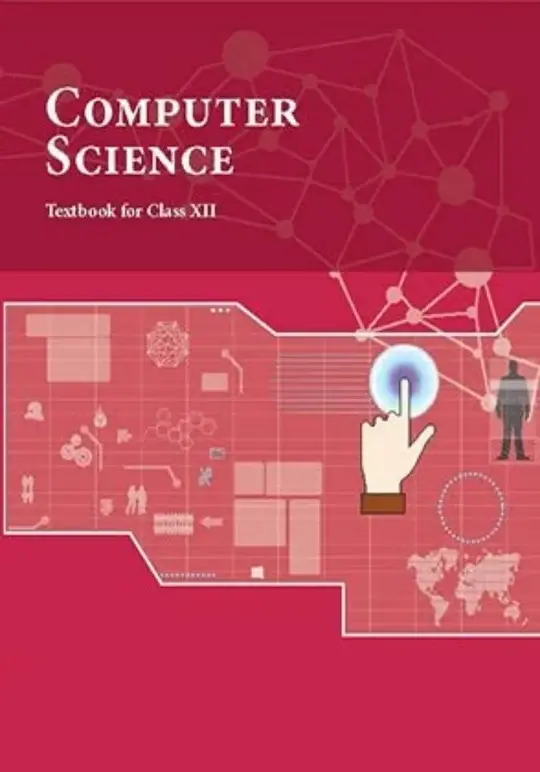
NCERT Computer Science For Class 12- Latest edition as per NCERT/CBSE
NCERT Computer Science — Class 12, Latest EditionFor CBSE Class XII Computer Science (083), the prescribed NCERT textbook is Computer Science — Textbook for Class XII. CBSE's official Senior Secondary Resources page directly lists the Class XII NCERT Computer Science textbook for subject code 083. The current CBSE curriculum is for academic session 2026–27. The official NCERT textbook portal provides the current rationalised textbook, including the prelims, chapters and complete-book download.
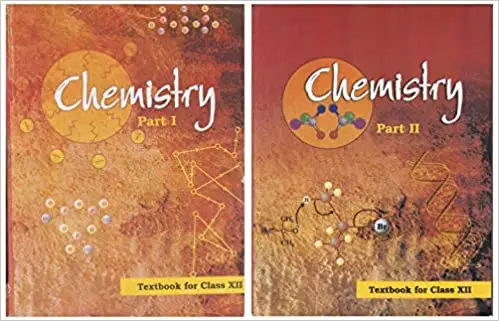
NCERT Chemistry Textbook for Class 12 - Part 1 & 2 - 12085 & 12086 (Set of 2 books)
Yes. For NCERT Class 12 Chemistry, the two books you mentioned are the official English-medium Chemistry Part I and Part II books, publication codes 12085 and 12086. NCERT’s official publication list confirms these codes and prices: Part I ₹130 and Part II ₹120. 📘 Chemistry Part I — Code 12085The current rationalised NCERT Part I contains 5 units.UnitChapterStarting pageDescription1Solutions1Types of solutions, concentration, solubility, vapour pressure, ideal/non-ideal solutions, colligative properties and abnormal molar masses.2Electrochemistry31Electrochemical cells, galvanic cells, Nernst equation, conductance, electrolysis, batteries, fuel cells and corrosion.3Chemical Kinetics61Rate of reaction, factors affecting reaction rate, integrated rate equations, temperature dependence and collision theory.4The d- and f-Block Elements89Position and electronic configurations of d-block elements, transition-element properties, important compounds, lanthanoids and actinoids.5Coordination Compounds118Coordination compounds, ligands, coordination number, nomenclature, bonding, isomerism and importance/applications.The current rationalised contents show Units 1–3 beginning at pages 1, 31 and 61, while Units 4 and 5 begin at 89 and 118 respectively. Part I — approximate page structureUnit 1: Solutions: pp. 1–30Unit 2: Electrochemistry: pp. 31–60Unit 3: Chemical Kinetics: pp. 61–88Unit 4: The d- and f-Block Elements: pp. 89–117Unit 5: Coordination Compounds: pp. 118–140Appendices: from p. 141Answers to Some Questions in Exercises: from p. 154The page numbering above is the printed NCERT textbook numbering, not the PDF viewer's page count. The rationalised contents corroborate the sequence and starting pages. 📗 Chemistry Part II — Code 12086Part II continues directly from Part I and contains Units 6–10, focusing predominantly on organic chemistry and biomolecules.UnitChapterStarting pageDescription6Haloalkanes and Haloarenes159Classification, nomenclature, C–X bond, preparation, physical/chemical properties and polyhalogen compounds.7Alcohols, Phenols and Ethers193Classification, nomenclature, structures, preparation and properties of alcohols, phenols and ethers; commercially important alcohols.8Aldehydes, Ketones and Carboxylic Acids227Carbonyl compounds, nomenclature, preparation, physical/chemical properties and uses of aldehydes, ketones and carboxylic acids.9Amines259Structure, classification, nomenclature, preparation and reactions of amines; diazonium salts and their synthetic importance.10Biomolecules281Carbohydrates, proteins, enzymes, vitamins, nucleic acids and hormones.These starting pages are from the current rationalised/reprint structure of Part II. Part II — approximate page structureUnit 6: Haloalkanes and Haloarenes: pp. 159–192Unit 7: Alcohols, Phenols and Ethers: pp. 193–226Unit 8: Aldehydes, Ketones and Carboxylic Acids: pp. 227–258Unit 9: Amines: pp. 259–280Unit 10: Biomolecules: pp. 281–302Answers to Some Questions in Exercises: from p. 303The current contents list Unit 10 beginning at 281 and the answers section at 303. 🎯 What the two books coverPart I — Physical + Inorganic ChemistryUnits 1–3SolutionsElectrochemistryChemical KineticsUnits 4–5d- and f-Block ElementsCoordination CompoundsSo Part I contains the major physical chemistry and inorganic chemistry components of the current rationalised Class XII NCERT text.Part II — Organic + Biological ChemistryUnits 6–9Haloalkanes and HaloarenesAlcohols, Phenols and EthersAldehydes, Ketones and Carboxylic AcidsAminesUnit 10BiomoleculesThus, Part II is predominantly organic chemistry, ending with biomolecules.📝 CBSE 2026–27 relevanceThe current CBSE Chemistry curriculum is Chemistry (043). CBSE states that the Class XI–XII Chemistry curriculum is designed to develop conceptual understanding and the ability to apply chemistry at macroscopic, molecular and symbolic levels. The current NCERT textbook portal also provides Chemistry II with its rationalised-content section, prelims, individual chapters and a complete-book download. Important distinctionThe NCERT textbook structure and the CBSE examination syllabus are not necessarily identical in page-for-page coverage. For exam preparation, the CBSE 2026–27 syllabus takes precedence over assuming that every page/topic appearing in an older NCERT edition is examinable. CBSE's current Chemistry curriculum is officially listed for 2026–27. 📖 Official sourcesNCERT official publication list: confirms 12085 Chemistry Part I and 12086 Chemistry Part II, including their official prices. NCERT Class XII Chemistry II textbook portalCBSE Chemistry 2026–27 syllabus — Subject 043Quick identification12085 — Chemistry Part I → Units 1–5 → pp. 1–154+ 12086 — Chemistry Part II → Units 6–10 → pp. 159–303+Official NCERT set price: ₹250 (₹130 + ₹120).
NCERT Business Studies I for Class 12 - latest edition as per NCERT/CBSE
📚 Chapter-wise description and pagesThe printed page numbers below refer to the latest NCERT 2026–27 reprint. The NCERT PDFs may display an additional PDF-page number, so I am giving the book's printed page number, which is the useful number when referring to the physical textbook.Ch.ChapterNCERT printed pagesDescription1Nature and Significance of Management1–28Meaning and characteristics of management, objectives and importance, efficiency/effectiveness, management as art, science and profession, levels of management, functions of management and coordination. 2Principles of Management29–68Meaning and significance of management principles, Fayol's principles, Taylor's Scientific Management, principles and techniques of Scientific Management.3Business Environment69–90Meaning, features and importance of business environment; economic, social, technological, political and legal dimensions; impact of government policies. The official NCERT chapter begins at printed page 69 and is marked Reprint 2026–27. 4Planning91–108Meaning, importance and limitations of planning; planning process; objectives, strategy, policy, procedure, method, rule, budget and programme. The current NCERT chapter is Reprint 2026–27. 5Organising109–136Meaning and importance of organising, organising process, organisational structures, functional and divisional structures, formal/informal organisation, delegation and decentralisation. The current NCERT material starts this chapter at printed page 109. 6Staffing137–160Meaning and importance of staffing, staffing process, recruitment, selection, training and development and methods of training.7Directing161–193Meaning and importance of directing; supervision, motivation, leadership and communication; communication process, barriers and measures to overcome them.8Controlling194–218Meaning and importance of controlling, relationship between planning and controlling, controlling process and techniques of managerial control. Current editions show the chapter extending through the 200s in printed numbering.
NCERT Accountancy II for Class 12 - latest edition as per NCERT/CBSE
NCERT Accountancy Part II for Class 12 is the second volume of the prescribed NCERT Accountancy textbook for senior secondary students. It focuses primarily on accounting for companies and analysis of financial statements. The book develops students' understanding of company accounts, preparation and presentation of financial statements, interpretation of accounting information, accounting ratios, and cash-flow analysis.The book is designed to build both conceptual understanding and practical accounting skills through explanations, illustrations, formats, accounting treatments and exercises. It is particularly relevant for CBSE students because the topics correspond closely with the CBSE Class XII Accountancy curriculum. Chapters in the current Part IIAccounting for Share Capital Covers the accounting treatment of issue and allotment of shares, equity and preference shares, oversubscription and undersubscription, issue at par/premium, calls in advance and arrears, issue for consideration other than cash, private placement, ESOP, forfeiture and reissue of shares, and presentation of share capital in the Balance Sheet. Issue and Redemption of Debentures Deals with the meaning and types of debentures, issue at par/premium/discount, issue for consideration other than cash, terms of redemption, debentures as collateral security, interest on debentures, writing off discount/loss on issue and redemption. Financial Statements of a Company Focuses on the preparation and presentation of company financial statements, particularly the Statement of Profit and Loss and Balance Sheet, using the prescribed formats and major headings/sub-headings under Schedule III of the Companies Act, 2013. Analysis of Financial Statements Introduces financial statement analysis, its objectives, importance and limitations, along with tools such as comparative statements and common-size statements for interpreting financial information. Accounting Ratios Covers the calculation and interpretation of important ratios, including liquidity, solvency, activity and profitability ratios, enabling students to evaluate a company's financial position and performance. Cash Flow Statement Deals with the meaning, objectives and preparation of a Cash Flow Statement, helping students understand the movement of cash and cash equivalents and assess the operating, investing and financing activities of a business.
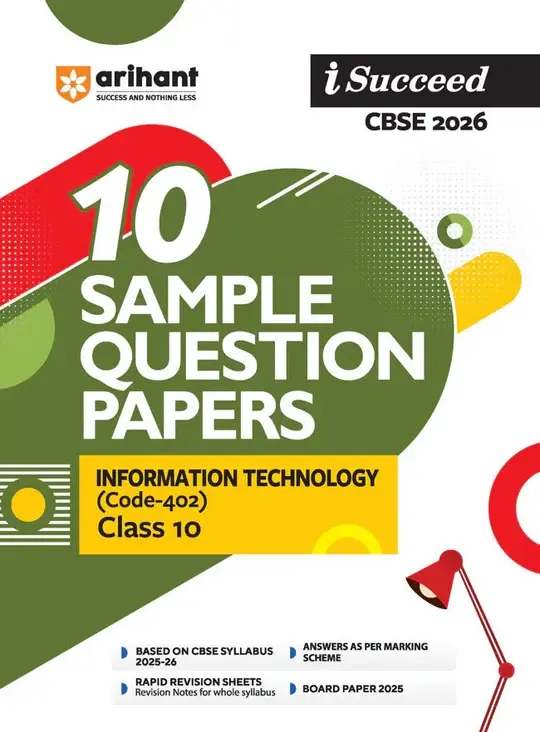
Arihant i-Succeed CBSE 2026— Information Technology (Code -402) Class 10 | 10 Sample Question
Arihant i-Succeed CBSE 2026 – Information Technology (Code 402), Class 10 is an exam-oriented practice book designed for students preparing for the CBSE Class 10 Information Technology board examination 2026. It is based on the updated CBSE 2026 syllabus and the official CBSE sample paper released in July 2025. 📚 What the book contains10 Sample Question Papers — Provides 10 complete board-style papers for extensive exam practice.Fully Solved Papers — Each sample paper includes step-by-step solutions to help students understand the expected method of answering.Competency-Based Questions — Includes competency-focused questions reflecting the current CBSE assessment approach.Case-Study Questions — Case-based practice is included in the papers to familiarise students with application-oriented questions.Rapid Revision Sheets — Concise revision material for quickly reviewing important Information Technology concepts before exams.Topic-wise Mind Maps — Visual summaries make last-minute revision and recall easier.Final 50 Questions — A selected set of important, exam-oriented questions for focused final preparation.Latest CBSE Sample Paper — Helps students understand the current paper structure, question style and marking pattern.Board Paper 2025 — Includes the fully solved CBSE 2025 Information Technology board paper, giving students a real examination reference.
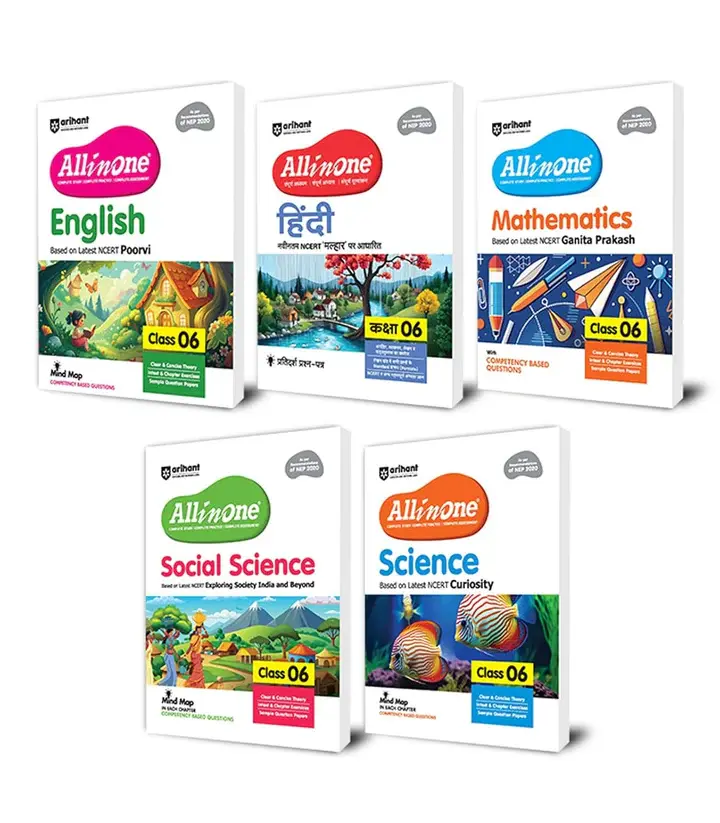
Arihant All In One Science, Social Science, Mathematics, English and Hindi Class 6th Based On Latest NCERT For CBSE Exams 2027
The Arihant All in One Class 6 Set of 5 Books is a comprehensive supplementary study package covering Science, Social Science, Mathematics, English and Hindi. It is designed around the latest NCERT curriculum and combines chapter-wise study material with practice, assessment and revision tools. The current Class 6 series reflects the newer NCERT books such as Curiosity (Science), Exploring Society: India and Beyond (Social Science), Ganita Prakash (Mathematics), Poorvi (English) and Malhar (Hindi). 📚 The 5 books includedSubjectBased on NCERT bookWhat it providesScienceCuriosityChapter-wise explanations, skill/competency-based questions, revision through mind maps and assessment practice.Social ScienceExploring Society: India and BeyondStructured theory, important facts, glossary, NCERT solutions, competency-based questions and mind maps.MathematicsGanita PrakashNCERT-aligned concepts, worked explanations, competency-based practice and assessment questions.EnglishPoorviLiterature/language-based explanations, chapter exercises, different question types, NCERT solutions and mind maps.HindiMalharNCERT-based Hindi content with chapter explanations, practice questions and revision/assessment support.Arihant's individual Class 6 books are explicitly described as latest-NCERT based and designed around study, practice and assessment. For example, the Science edition covers 12 chapters and includes skill-based questions and sample papers, while the Social Science edition covers 14 chapters and includes sample papers, glossary, NCERT solutions and mind maps.
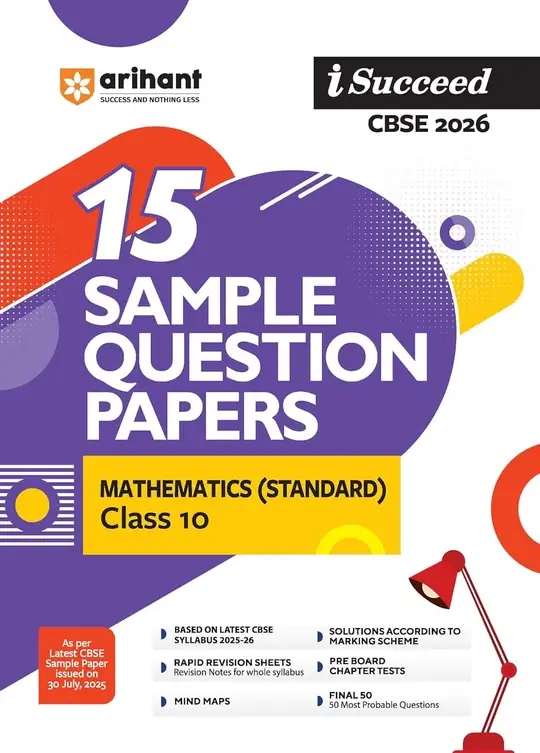
Arihant I Succeed CBSE Sample Question Papers Class 10 Mathematics Standard Exam 2026 | 15 Sample Papers | Rapid Revision Sheets
Arihant i-Succeed CBSE 2026 – Mathematics (Standard) Class 10 is an exam-focused sample-paper book designed for students preparing for the CBSE Class 10 Mathematics Standard Board Examination 2026. It follows the latest CBSE syllabus and the official CBSE sample-paper pattern, and combines full-length papers with quick-revision and targeted practice tools. 📚 What the book contains15 Full-Length Sample Papers — Provides extensive practice in the CBSE board-exam format, helping students become familiar with the structure, question types and time management.3 Stages of Sample Papers — Practice is organised progressively to help students move from preparation to exam-level practice.Rapid Revision Sheets — Concise revision material for quickly reviewing important concepts and the syllabus before tests or the board exam.Pre-Board Chapter Tests — Chapter-focused tests help identify weak areas before attempting full sample papers.Mind Maps — Visual revision aids for quick recall of important concepts and connections.Final 50 Questions — A focused collection of important/high-priority questions for final-stage preparation.Fully Solved Board Paper 2025 — Provides a recent actual board-paper reference for understanding the expected level and presentation.Solutions as per CBSE Marking Scheme — Step-by-step solutions demonstrate how answers should be presented and how marks are awarded, which is especially useful for Mathematics Standard.
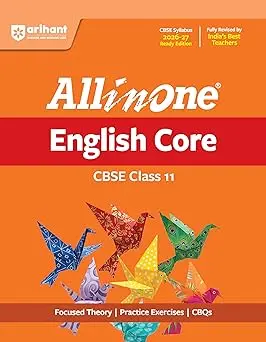
Arihant All in One English Core Class 11 for CBSE Exam 2026-27 | NCERT Based Complete Theory, Practice Exercises
Arihant All in One English Core Class 11 for CBSE Exam 2026–27 is a comprehensive, NCERT-based preparation book designed for CBSE Class 11 English Core. The 2026–27 Ready Edition combines theory, chapter-wise practice, competency-based questions, Assertion–Reason questions, self-assessment, mind maps and sample-paper practice in one book. 📖 What the book providesComplete NCERT-based theory — Concepts and literature content are explained in a structured, student-friendly manner.Chapter-wise explanations — Helps students understand the prescribed English Core material rather than simply memorising answers.Practice exercises — Provides graded questions for regular practice and exam preparation.Competency-Based Questions (CBQs) — Includes questions designed around the competency-focused approach used in current CBSE assessment.Assertion–Reason (A–R) questions — Additional practice for analytical and conceptual question formats.Self-evaluation exercises — Each chapter includes assessment opportunities so students can check their preparation.Mind Maps — Visual summaries help with quick revision of chapters and important concepts.Sample Paper — Includes a sample paper based on the latest examination pattern.Exam-oriented preparation — The book is intended to combine learning, practice, assessment and revision rather than requiring several separate reference books. 🎯 Best suited forThis book is particularly useful if you want one supplementary book alongside NCERT for Class 11 English Core. It can be used for:NCERT study → concept/theory revision → chapter practice → CBQs/A–R → self-assessment → mind-map revision → sample-paper practice.Arihant describes it as suitable for students seeking conceptual clarity and exam readiness, with content revised according to the CBSE 2026–27 syllabus.
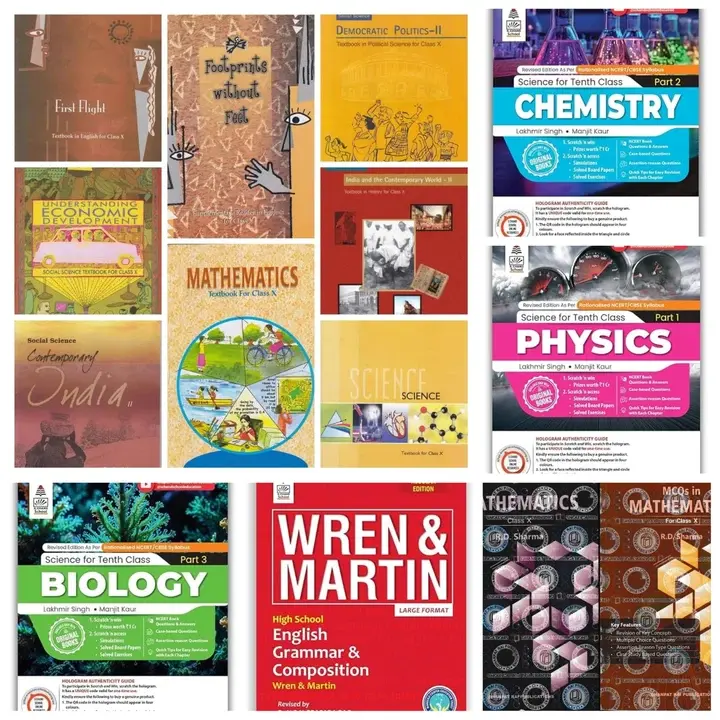
Class 10th NCERT with R.D. Sharma, Lakhmir Singh, Wren & Martin, (13 books) - Latest edition as per NCERT/CBSE(2026-27)
The Class 10th NCERT with R.D. Sharma, Lakhmir Singh & Wren & Martin — 13 Books is a comprehensive English-medium Class 10 study package combining the prescribed NCERT textbooks with additional reference books for Mathematics, Science and English grammar. The current Booksfy listing specifically identifies it as the 2026–27 edition, while Shyam Books describes it as the latest edition according to the NCERT/CBSE syllabus. It is intended to support students from regular classroom study and homework through examination preparation, additional practice and revision.