For science undergraduates across India, qualifying for an Indian Institute of Technology (IIT) or the Indian Institute of Science (IISc) is one of the most prestigious milestones. The Joint Admission test for Masters (IIT JAM) is your national gateway to premier postgraduate degree programs, research avenues, and academic careers.
Whether your goal is an M.Sc., Joint M.Sc.-Ph.D., or M.Sc.-Ph.D. Dual Degree, here is everything you need to know to navigate IIT JAM with clarity and confidence.
What is IIT JAM?
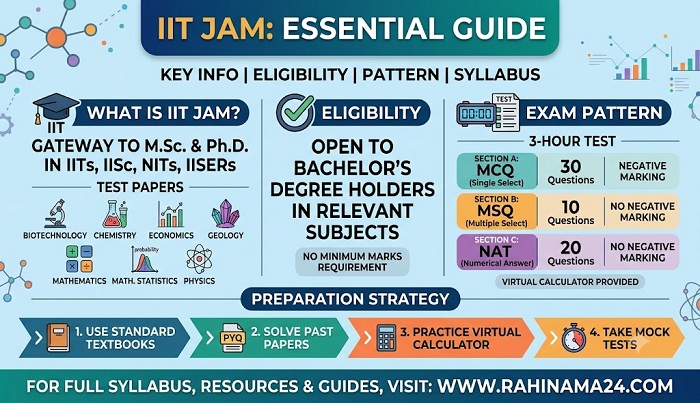
The Joint Admission test for Masters (JAM) is an all-India entrance examination conducted annually on a rotational basis by one of the IITs on behalf of the Ministry of Education (MoE), Government of India.
Qualifying JAM opens admissions to:
- All Indian Institutes of Technology (IITs)
- IISc Bengaluru (Integrated Ph.D. programs)
- National Institutes of Technology (NITs) and CFTIs (through CCMN counseling)
- IISERs and other top research institutes accepting JAM scores
Test Papers Offered
IIT JAM is conducted as an online Computer Based Test (CBT) across seven subjects:
- Biotechnology (BT)
- Chemistry (CY)
- Economics (EN)
- Geology (GG)
- Mathematics (MA)
- Mathematical Statistics (MS)
- Physics (PH)
Candidates may appear in either one or two test papers, provided the two sessions do not clash on the exam schedule.
Eligibility Criteria
- Academic Qualification: Candidates must hold a Bachelor’s degree in a relevant discipline from a recognized university. Candidates in the final year of their qualifying undergraduate program are also eligible to apply.
- Minimum Marks: In accordance with recent regulatory revisions, there is no aggregate percentage cut off imposed by the JAM organizing committee; simply passing the qualifying degree satisfies general eligibility. Individual admitting institutes (IITs/IISc/NITs) enforce specific subject-level Minimum Educational Qualifications (MEQs) during admissions.
- Age Limit & Nationality: There is no age restriction. Both Indian and foreign nationals are eligible to apply.
Exam Pattern & Marking Scheme
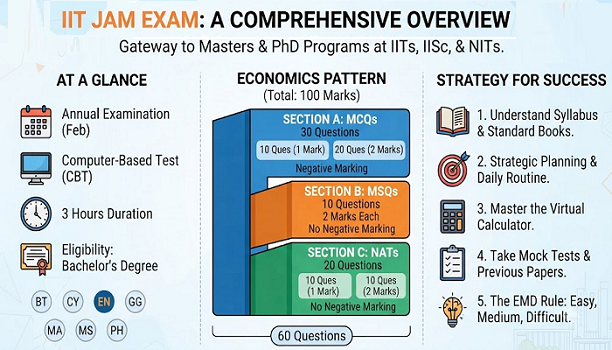
The examination is conducted for 3 hours and consists of 60 questions carrying a total of 100 marks. The question paper is divided into three sections:
Section A – Multiple Choice Questions (MCQ)
- Total Questions: 30
- 10 questions × 1 mark
- 20 questions × 2 marks
- Negative Marking: Yes
- 1-mark question: 1/3 mark deducted for an incorrect answer
- 2-mark question: 2/3 mark deducted for an incorrect answer
Section B – Multiple Select Questions (MSQ)
- Total Questions: 10
- Marks: 2 marks per question
- Negative Marking: No
- Partial Marking: No
Section C – Numerical Answer Type (NAT)
- Total Questions: 20
- 10 questions × 1 mark
- 10 questions × 2 marks
- Negative Marking: No
High-Yield Syllabus Breakdown by Subject
Physics (PH)
- Mathematical Methods (vector calculus, differential equations, matrices)
- Mechanics and General Properties of Matter (Newton's laws, Kepler’s problem, fluid dynamics)
- Oscillations, Waves, and Optics (damped/forced oscillations, interference, diffraction)
- Electricity and Magnetism (Maxwell’s equations, Biot-Savart, Lorentz force)
- Kinetic Theory, Thermodynamics (laws of thermodynamics, entropy, phase transitions)
- Modern Physics (special relativity, photoelectric effect, Bohr model, Schrödinger equation)
- Solid State Physics, Devices, and Electronics (semiconductors, operational amplifiers)
Chemistry (CY)
- Physical Chemistry: Atomic structure, chemical kinetics, quantum chemistry, thermodynamics, electrochemistry, spectroscopy.
- Inorganic Chemistry: Periodic table, coordination chemistry, main group elements, organometallics, bioinorganic chemistry.
- Organic Chemistry: Reaction mechanisms, stereochemistry, organic synthesis, aromatic and heterocyclic compounds, biomolecules.
Mathematics (MA)
- Real Analysis (sequences, series, functions of single and multivariable calculus)
- Linear Algebra (vector spaces, linear transformations, matrices, eigenvalues)
- Differential Equations (ordinary differential equations, integrating factors)
- Abstract Algebra (groups, subgroups, cyclic groups, permutation groups)
Biotechnology (BT)
- General Biology, Biochemistry, Microbiology, Cell Biology, Molecular Biology, Genetics, and basic 10+2 Mathematics, Chemistry, and Physics.
4-Step Strategic Preparation Plan
- Master the Standard Textbooks Early
- Move past surface-level multiple-choice collections. Build concepts using foundational undergraduate texts (e.g., Griffiths/Morrison & Boyd/H.C. Verma/Gallian) to tackle Section B (MSQs), where partial knowledge leads to zero marks.
- Decode Previous Years' Question Papers (PYQs)
- Analyze at least the last 10 years of solved question papers. Identify recurring concepts, problem patterns, and the depth of mathematical derivations required.
- Practice with the Virtual Calculator
- NAT questions require exact decimal entries. Inefficient use of the on-screen digital calculator can consume valuable exam minutes. Practice inputting complex calculations via browser-based simulator tools.
- Take Timed Sectional & Full-Length Mock Tests
- Section A demands caution to avoid negative marks, Section B requires rigorous verification, and Section C rewards high-speed calculation accuracy. Mock tests ensure balanced time allocation across all 60 questions.
Key Takeaway
Securing a top rank in IIT JAM is about analytical depth, question selection, and steady revision rather than attempting every question on the paper. Start early, track your weekly problem-solving benchmarks, and maintain consistency in your subject revisions.
For more structured academic guides, entrance updates, and curated STEM resources, stay tuned to rahinama24.com.