Study Materials & Books
Explore our complete catalog of toppers handwritten notes, curated textbooks, formulas, and competitive exam preparation resources.
IGNOU BOOK | Sociology of India - II[English medium] BSOC-104
Sociology of India – II: DescriptionSociology of India – II is an advanced course that examines the major social structures, institutions, inequalities, and processes of change in contemporary Indian society. Building on the foundations of Sociology of India – I, the course provides a deeper understanding of the diverse and changing nature of Indian society through sociological perspectives.The course focuses on issues such as caste, class, tribe, gender, religion, family, rural and urban transformation, social movements, development, globalization, and identity politics. It explores how traditional social structures interact with modern economic, political, and cultural processes.Major areas coveredCaste and social inequality: Changing caste relations, caste mobility, affirmative action, Dalit experiences, and contemporary caste politics.Tribes and marginal communities: Tribal identity, displacement, development, marginalization, and struggles for rights and resources.Class and economic change: Changing class structures, inequality, poverty, employment, and the emergence of new middle classes.Gender and society: Patriarchy, women's movements, gender inequality, changing family roles, and intersectional experiences.Religion and communal relations: Religious diversity, secularism, communalism, religious identities, and their influence on social relations.Family and kinship: Changing patterns of marriage, family, household, kinship, and intergenerational relationships.Rural and urban transformations: Agrarian change, migration, urbanization, informal work, and changing rural–urban relationships.Social movements: Dalit, women's, tribal, environmental, farmers', and other movements for rights and social justice.Development and globalization: Economic reforms, globalization, development policies, inequality, migration, and their social consequences.Contemporary Indian society: Identity, citizenship, social exclusion, technology, education, media, and emerging social issues.
IGNOU BOOK | Sociology of India [Hindi medium] BSOC-132
BSOC-132: Sociology of India (Hindi Medium) is an IGNOU sociology course that focuses on understanding Indian society, its social structure, institutions, diversity, and processes of social change.मुख्य विषयभारतीय समाज की संरचनाभारतीय समाज की प्रमुख विशेषताएँविविधता और एकताग्रामीण एवं नगरीय समाजजाति व्यवस्थाजाति की अवधारणा और विशेषताएँजाति व्यवस्था में परिवर्तनदलित एवं पिछड़े वर्गजनजातीय समाजजनजातियों की सामाजिक संरचनाजनजातीय पहचान और समस्याएँजनजातीय परिवर्तनपरिवार और विवाहभारतीय परिवार की विशेषताएँसंयुक्त एवं एकल परिवारविवाह के प्रकार और बदलते स्वरूपधर्म और सामाजिक जीवनभारत में धार्मिक विविधताधर्म और सामाजिक संबंधसाम्प्रदायिकता तथा धर्मनिरपेक्षतासामाजिक परिवर्तनआधुनिकीकरणसंस्कृतिकरणपश्चिमीकरणवैश्वीकरण और भारतीय समाजमहिला एवं लैंगिक संबंधभारतीय समाज में महिलाओं की स्थितिलैंगिक असमानतामहिला सशक्तीकरणसामाजिक आंदोलनकिसान आंदोलनदलित आंदोलनमहिला आंदोलनजनजातीय एवं पर्यावरण आंदोलन
IGNOU BOOK | Sociology of India[ English medium] BSOC-132
BSOC-132 – Sociology of India is a sociology course that focuses on Indian society, its social structure, institutions, diversity, inequalities, and processes of social change.📚 Main focus of BSOC-132The course helps students understand Indian society from a sociological perspective, including:Understanding Indian SocietyFeatures and characteristics of Indian societyUnity and diversityPluralism and multiculturalismCaste SystemMeaning and characteristics of casteCaste hierarchy and social mobilityChanging nature of caste in modern IndiaCaste and politicsTribal CommunitiesMeaning and characteristics of tribesTribal identity and cultureProblems faced by tribal communitiesTribal development and social changeFamily and KinshipTypes of Indian familiesJoint and nuclear familiesMarriage and kinshipChanges in family and marriageReligion and SocietyReligion in Indian societyReligious diversitySecularismCommunalism and its social implicationsSocial Stratification and InequalityCaste, class and genderSocial exclusionInequality and discriminationMarginalised communitiesProcesses of Social ChangeSanskritisationWesternisationModernisationSecularisationGlobalisationRural and Urban SocietyIndian village and rural social structureUrbanisationMigrationChanging rural–urban relationships👨🏫 Important Indian sociologistsWhile studying Sociology of India, you are likely to encounter thinkers such as:G. S. Ghurye – caste, tribe and Indian social structureM. N. Srinivas – Sanskritisation, Westernisation and dominant casteA. R. Desai – Marxist approach and Indian nationalismLouis Dumont – caste and hierarchyIrawati Karve – family, kinship and social organisation
IGNOU BOOK | Sociology of Gender[Hindi medium] BSOC-107
Sociology of Gender: DescriptionSociology of Gender is a branch of sociology that examines how societies construct, define, and regulate gender, gender roles, identities, and relationships. The course explores gender not simply as a biological difference, but as a social and cultural phenomenon shaped by institutions, norms, values, and power relations.Major areas coveredSex and gender: Understanding the distinction between biological sex and socially constructed gender.Gender socialization: How family, education, media, religion, peer groups, and other institutions shape gender identities and expectations.Gender roles and stereotypes: Examination of socially prescribed roles and expectations associated with masculinity and femininity.Patriarchy: Understanding male-dominated social structures and their effects on women and other gender groups.Gender and power: Exploring inequalities in access to resources, authority, opportunities, and decision-making.Masculinities and femininities: Studying how different forms of masculinity and femininity are socially produced and experienced.Gender and work: Gender division of labour, unpaid domestic work, occupational segregation, wage inequality, and women's participation in the workforce.Gender and institutions: The role of family, education, politics, economy, religion, and media in reproducing or challenging gender inequalities.Intersectionality: Examining how gender interacts with class, caste, race, ethnicity, sexuality, religion, disability, and other social identities.Gender and social change: Studying feminism, women's movements, LGBTQ+ movements, and changing ideas about gender and equality.
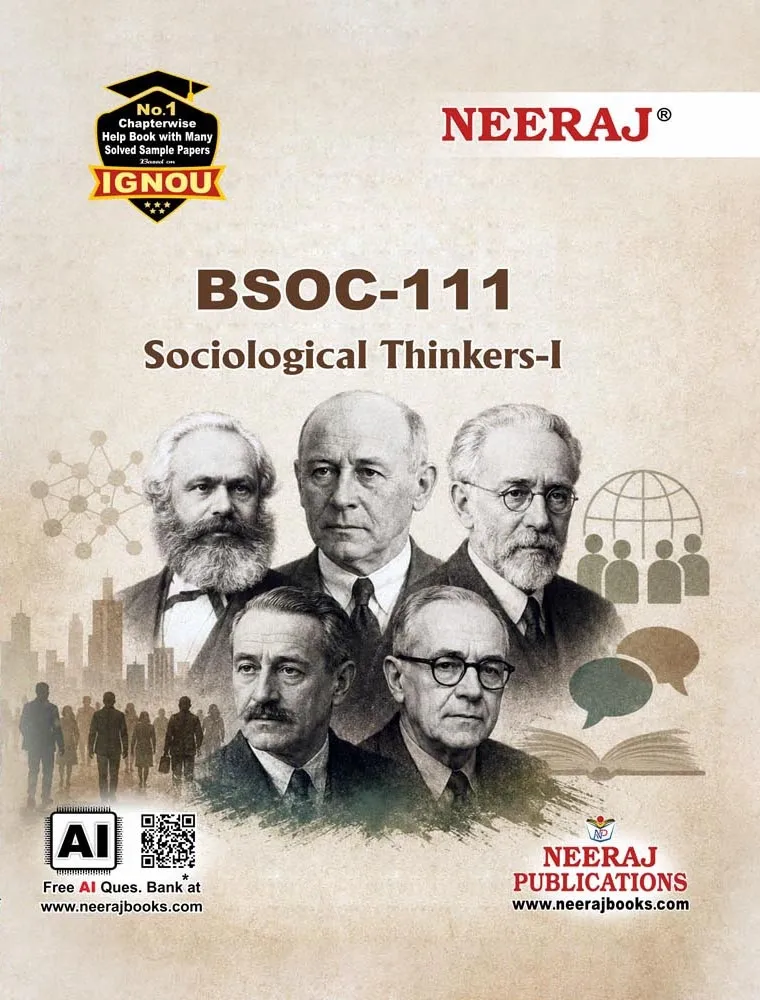
IGNOU BOOK | Sociological Thinkers-I[ English medium] BSOC-111
BSOC-111: Sociological Thinkers-I is a sociology course that introduces students to the major classical sociological thinkers and their ideas. The course helps you understand how sociology developed as a discipline and how different thinkers explained society, social order, conflict, change, and modernity.Major Thinkers and Concepts1. Auguste ComteFather of SociologyLaw of Three StagesTheological stageMetaphysical stagePositive stagePositivismSocial statics and social dynamics2. Karl MarxHistorical materialismClass and class conflictBourgeoisie and proletariatCapitalismAlienationExploitationBase and superstructureRevolution and social change3. Émile DurkheimSocial factsDivision of labourMechanical and organic solidarityCollective conscienceAnomieSuicideReligion and society4. Max WeberSocial actionTypes of social actionVerstehenIdeal typeAuthority:TraditionalCharismaticLegal-rationalBureaucracyProtestant ethic and capitalismWhat BSOC-111 Mainly TeachesThe course examines questions such as:What is society and how should it be studied?How does social order develop?Why do societies experience conflict and change?How did capitalism and modernity emerge?What causes social inequality?How do individuals and institutions interact?How can sociology scientifically study social life?
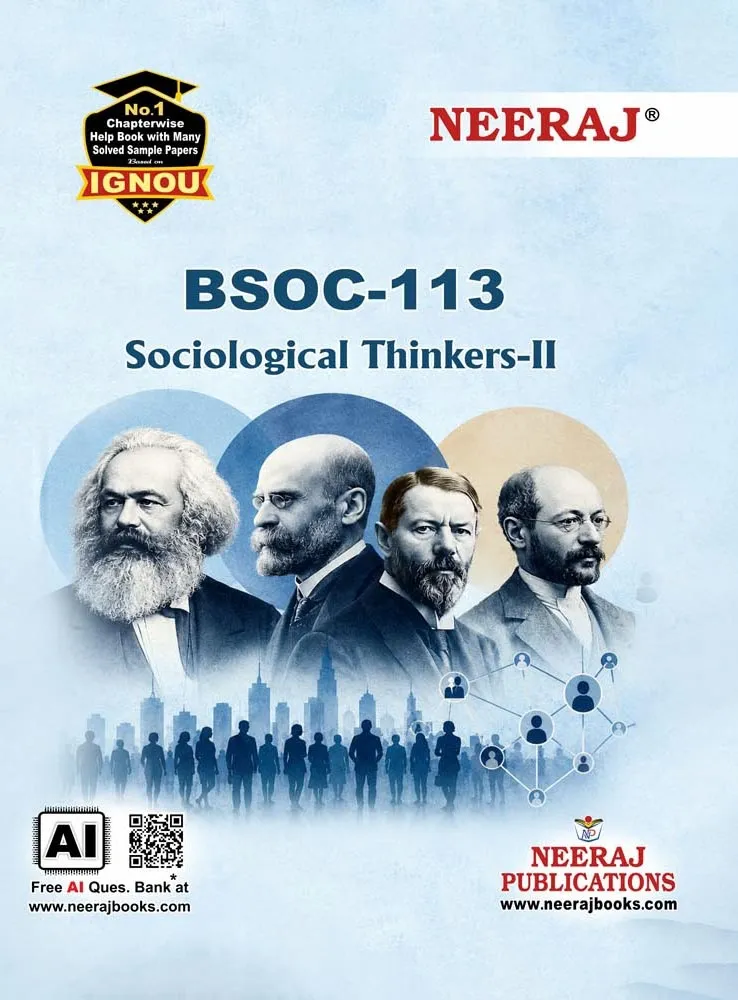
IGNOU BOOK | Sociological Thinkers- II[English medium] BSOC 113
BSOC-113 (Sociological Thinkers–II) is a sociology course that introduces students to the major sociological thinkers and their important theories, especially thinkers who developed sociology after the classical period.Main focus of the courseThe course generally helps you understand:Major sociological thinkers and their backgrounds.Their key concepts and theories.How these thinkers explained society, social structure, culture, power, inequality and social change.The relevance of their ideas to contemporary society.Important thinkers usually coveredDepending on the university syllabus, BSOC-113 commonly deals with thinkers such as:George Herbert Mead — self, mind, society and symbolic interactionism.Talcott Parsons — structural functionalism and social system.Robert K. Merton — manifest/latent functions, dysfunctions and theories of the middle range.C. Wright Mills — sociological imagination and the power elite.Erving Goffman — dramaturgical approach and presentation of self.Pierre Bourdieu — habitus, field and different forms of capital.Michel Foucault — power, knowledge, discourse and discipline.Jürgen Habermas — communicative action and the public sphere.
IGNOU BOOK | Sociological Theories [Hindi medium] BSOC-133
BSOC-133: Sociological Theories समाजशास्त्र की प्रमुख सैद्धान्तिक अवधारणाओं और दृष्टिकोणों का अध्ययन करने वाला पाठ्यक्रम है। इसमें यह समझने का प्रयास किया जाता है कि समाज कैसे व्यवस्थित होता है, सामाजिक संबंध कैसे बनते हैं, असमानता और संघर्ष क्यों पैदा होते हैं तथा समाज में परिवर्तन कैसे होता है।मुख्य विषय1. समाजशास्त्रीय सिद्धान्त का परिचयसमाजशास्त्रीय सिद्धान्त का अर्थसिद्धान्त की आवश्यकता और महत्वसमाज को समझने में समाजशास्त्रीय दृष्टिकोणMicro और Macro approaches2. संरचनात्मक-कार्यात्मक दृष्टिकोण (Structural Functionalism)समाज को एक व्यवस्था के रूप में देखनासामाजिक संस्थाओं के कार्यसामाजिक व्यवस्था और स्थिरताप्रमुख विचारक: Talcott Parsons, Robert K. MertonManifest और Latent functionsDysfunction3. संघर्ष सिद्धान्त (Conflict Theory)समाज में शक्ति और असमानतावर्ग और हितों का संघर्षप्रभुत्व और सामाजिक परिवर्तनKarl Marx के विचारों का प्रभावबाद के संघर्ष सिद्धान्त4. प्रतीकात्मक अन्तःक्रियावाद (Symbolic Interactionism)दैनिक जीवन में सामाजिक अन्तःक्रियाSymbols और meaningsव्यक्ति और समाज का संबंधGeorge Herbert MeadHerbert BlumerSelf और identity5. फेनोमेनोलॉजी (Phenomenology)सामाजिक वास्तविकता का निर्माणव्यक्ति के अनुभव और अर्थAlfred Schutzरोजमर्रा के जीवन की समझ6. Ethnomethodologyलोग दैनिक जीवन में सामाजिक व्यवस्था कैसे बनाते हैंCommon-sense knowledgeसामाजिक व्यवहार को समझने के तरीकेHarold Garfinkel7. Feminist TheoryGender और powerपितृसत्ता (Patriarchy)लैंगिक असमानतामहिलाओं के अनुभवों का समाजशास्त्रीय अध्ययनFeminist perspectives8. Critical Theoryसमाज में सत्ता, विचारधारा और प्रभुत्वसंस्कृति और मीडिया की भूमिकासामाजिक मुक्ति और परिवर्तनFrankfurt School का योगदान
IGNOU BOOK | Sociological Theories[ English medium] BSOC-133
BSOC-133 Sociological Theories is a sociology course that introduces the major thinkers, concepts, and theoretical perspectives used to understand society and social relationships.Main topics generally coveredMeaning and Nature of Sociological TheoryMeaning of theoryImportance of theory in sociologyRelationship between theory and empirical researchMajor approaches to understanding societyFunctionalismSociety as a system of interconnected partsSocial order and stabilitySocial functions and institutionsMajor ideas of Émile Durkheim and Talcott ParsonsManifest and latent functionsConflict TheorySociety as an arena of inequality and conflictPower, class and social changeKarl Marx's ideas on class struggle, capitalism and social changeContributions of later conflict theoristsSymbolic InteractionismMeaning and symbols in everyday lifeSelf and societySocial interactionGeorge Herbert Mead and Herbert BlumerHow people construct social reality through interactionMax Weber's Sociological TheorySocial actionTypes of social actionVerstehenAuthority and legitimacyBureaucracyRationalizationFeminist Sociological TheoryGender inequalityPatriarchyGender and powerFeminist approaches to understanding societyCritique of traditional sociological theoriesContemporary Sociological TheoriesStructurationPractice theorySocial construction of realityPostmodern perspectivesDevelopments in contemporary sociological thought
IGNOU BOOK | Sociological Research Methods-II[English medium] BSOC-114
Sociological Research Methods–II is a sociology course focused on the advanced methods used to conduct, analyze, and present sociological research.📚 BSOC-114 — Sociological Research Methods-IIThe course generally covers:Research DesignMeaning and types of research designExploratory, descriptive and explanatory researchFormulating research problems and hypothesesSamplingMeaning and importance of samplingProbability sampling: random, stratified, systematic and cluster samplingNon-probability sampling: purposive, quota and snowball samplingMethods of Data CollectionObservationInterviewQuestionnaire and scheduleCase studyDocuments and secondary dataQuantitative Data AnalysisClassification and tabulation of dataFrequency distributionsPercentages and averagesMeasures of central tendencyIntroduction to correlation and other statistical techniquesQualitative ResearchMeaning and characteristicsEthnographyParticipant observationIn-depth interviewsContent and thematic analysisResearch EthicsInformed consentConfidentiality and anonymityObjectivity and researcher responsibilityEthical issues in field researchReport WritingStructure of a research reportAnalysis and interpretationCitation and referencingPresentation of findings and conclusions
IGNOU BOOK | Sociological Research Methods-I[English medium] BSOC-112
Sociological Research Methods-I is a foundational course that explains how sociologists systematically study society, social relationships, institutions, behaviour, and social problems. It introduces the basic concepts, approaches, methods, and techniques used in sociological research.1. Meaning of Sociological ResearchSociological research is the systematic and scientific study of society. It involves collecting, analysing, and interpreting information to understand social phenomena.For example, a sociologist may conduct research on:Poverty and inequalityCaste and social mobilityGender relationsEducationFamily and marriageUrbanisationMigrationSocial change2. Objectives of Sociological ResearchThe major objectives are:Description – To describe social conditions and patterns.Explanation – To understand why a social phenomenon occurs.Prediction – To identify possible future trends.Understanding – To understand people's experiences, meanings, and behaviour.Theory building – To develop or test sociological concepts and theories.3. Scientific Approach in SociologySociological research generally follows a systematic process:Selection of topic → Research question → Review of literature → Research design → Data collection → Data analysis → Interpretation → Report writingResearchers try to maintain objectivity, reliability, validity, and ethical standards.4. Major Approaches to Sociological ResearchA. Quantitative ApproachThis approach uses numerical data and statistical techniques.Examples:SurveysQuestionnairesStatistical analysisCensus dataIt is useful for identifying patterns and relationships among large populations.B. Qualitative ApproachThis approach focuses on meanings, experiences, opinions, and social interactions.Examples:InterviewsParticipant observationCase studiesEthnographyIt provides detailed information about people's everyday lives.5. Important Research MethodsSurvey Method:Information is collected from a relatively large number of respondents, usually through questionnaires or structured interviews.
IGNOU BOOK | Society Through the Visual[Hindi medium] BSOS-185
समाज को दृश्य माध्यमों के द्वारा समझना“Society Through the Visual” का अर्थ है दृश्य माध्यमों (Visuals) के द्वारा समाज का अध्ययन और समझ। इसमें चित्र, फोटोग्राफ, फिल्म, विज्ञापन, पोस्टर, टेलीविजन, सोशल मीडिया, कला आदि को समाज को समझने के स्रोत के रूप में देखा जाता है।1. दृश्य माध्यम क्या हैं?दृश्य माध्यम वे साधन हैं जिनके द्वारा किसी विचार, घटना, व्यक्ति या सामाजिक जीवन को चित्र या दृश्य रूप में प्रस्तुत किया जाता है। जैसे:फोटोग्राफफिल्म और टेलीविजनचित्रकलाविज्ञापनपोस्टर और कार्टूनसोशल मीडिया की तस्वीरें और वीडियोसमाचारों के दृश्य2. समाज को दृश्य माध्यमों से समझनादृश्य माध्यम केवल मनोरंजन या सूचना देने का साधन नहीं हैं, बल्कि वे समाज की संस्कृति, विचारधारा, सामाजिक संबंधों और असमानताओं को भी दिखाते हैं।उदाहरण के लिए, किसी फिल्म में परिवार को जिस प्रकार दिखाया जाता है, उससे उस समय के परिवार, लैंगिक भूमिकाओं और सामाजिक मूल्यों के बारे में जानकारी मिल सकती है।3. दृश्य और संस्कृतिदृश्य माध्यम समाज की संस्कृति को प्रदर्शित और प्रभावित दोनों करते हैं। पहनावा, भोजन, त्योहार, भाषा, धार्मिक प्रतीक और जीवन-शैली आदि को चित्रों और फिल्मों के माध्यम से समझा जा सकता है।4. दृश्य और सामाजिक असमानतादृश्य सामग्री के माध्यम से जाति, वर्ग, लिंग, गरीबी, अमीरी और सामाजिक शक्ति जैसी असमानताओं का अध्ययन किया जा सकता है। उदाहरण के लिए, विज्ञापनों में महिलाओं और पुरुषों की भूमिकाओं का चित्रण समाज में मौजूद लैंगिक धारणाओं को दर्शा सकता है।5. दृश्य केवल वास्तविकता का प्रतिबिंब नहीं हैंयह समझना महत्वपूर्ण है कि हर तस्वीर या फिल्म पूरी सामाजिक वास्तविकता नहीं दिखाती। दृश्य का निर्माण किसी व्यक्ति, संस्था या मीडिया द्वारा किया जाता है। इसलिए उसमें चयन, दृष्टिकोण और कभी-कभी पक्षपात भी हो सकता है।6. दृश्य समाज को प्रभावित भी करते हैंदृश्य माध्यम लोगों की सोच, पसंद, व्यवहार और सामाजिक धारणाओं को प्रभावित कर सकते हैं। विज्ञापन उपभोक्ता व्यवहार को प्रभावित करते हैं, जबकि फिल्में और सोशल मीडिया सुंदरता, सफलता, परिवार और जीवन-शैली की धारणाएँ बना सकते हैं।निष्कर्षSociety Through the Visual समाज को केवल लिखित शब्दों से नहीं, बल्कि चित्रों, फिल्मों, विज्ञापनों और अन्य दृश्य माध्यमों के माध्यम से समझने का दृष्टिकोण है। यह हमें यह समझने में मदद करता है कि समाज स्वयं को कैसे प्रस्तुत करता है और दृश्य माध्यम सामाजिक पहचान, संस्कृति, शक्ति और असमानता को किस प्रकार दर्शाते और प्रभावित करते हैं।
IGNOU BOOK | Society Through the Visual[ English medium] BSOS -185
BSOS-185: Society Through the Visual is an interdisciplinary course that explores society and culture through visual forms such as photographs, films, advertisements, paintings, television, social media, architecture, and other images.The basic idea is that visuals do not simply show society—they also shape how we understand society.Main Areas Covered1. Understanding the VisualMeaning of visual cultureWhat is a visual?Relationship between images and societyHow people interpret and give meaning to imagesVisual representation2. Visual Culture and SocietyHow society produces visual imagesHow visuals reflect social values and beliefsRelationship between culture, identity and representationPower and the production of images3. Photography and SocietyPhotography as a way of documenting social lifePhotographs and memoryRepresentation of people and communitiesDocumentary photographyEthics of photographing people4. Cinema and SocietyFilm as a reflection of societyRepresentation of class, caste, gender and communityCinema and social changePopular culture and mass media5. Advertising and Visual CommunicationRole of advertisements in everyday lifeCreation of consumer identitiesRepresentation of beauty, gender and lifestyleAdvertisements and consumer culture6. Television and Popular Visual CultureTelevision as a social institutionRepresentation of family and everyday lifeNews and visual representationPopular culture and social values7. Gender and the VisualRepresentation of women and menGender stereotypesThe male gazeBody and beautyFeminist approaches to visual culture8. Digital and Social MediaInstagram, YouTube and other digital platformsSelfies and online identityMemes and visual communication
IGNOU BOOK | Social Stratification [Hindi medium] BSOC-110
सामाजिक स्तरीकरण (Social Stratification) — BSOC-110सामाजिक स्तरीकरण का अर्थ समाज में व्यक्तियों और समूहों का ऊँचे-नीचे सामाजिक स्तरों (स्तरों/परतों) में विभाजन है। यह विभाजन धन, शक्ति, प्रतिष्ठा, जाति, वर्ग, लिंग, शिक्षा आदि के आधार पर हो सकता है। इसमें समाज के कुछ लोगों को अधिक अवसर और संसाधन मिलते हैं, जबकि कुछ लोग उनसे वंचित रह जाते हैं।सरल शब्दों में: समाज में लोगों की सामाजिक स्थिति समान न होकर विभिन्न स्तरों में बँटी होती है, इसे सामाजिक स्तरीकरण कहते हैं।सामाजिक स्तरीकरण की प्रमुख विशेषताएँसामाजिक प्रकृति — यह समाज द्वारा निर्मित व्यवस्था है।पदानुक्रम (Hierarchy) — इसमें कुछ समूह ऊँचे और कुछ नीचे माने जाते हैं।असमानता — संसाधनों, अवसरों और अधिकारों का समान वितरण नहीं होता।सर्वव्यापकता — लगभग हर समाज में किसी न किसी रूप में स्तरीकरण पाया जाता है।स्थायित्व और परिवर्तनशीलता — कुछ व्यवस्थाएँ लंबे समय तक बनी रहती हैं, लेकिन सामाजिक परिवर्तन के साथ उनमें बदलाव भी आता है।सामाजिक गतिशीलता — विशेषकर वर्ग-आधारित व्यवस्था में व्यक्ति एक सामाजिक स्तर से दूसरे स्तर पर जा सकता है।सामाजिक स्तरीकरण के प्रमुख आधारजाति (Caste)वर्ग (Class)लिंग (Gender)आय और संपत्तिशक्ति और राजनीतिक प्रभावशिक्षा और व्यवसायसामाजिक प्रतिष्ठासामाजिक स्तरीकरण के उदाहरणभारत में जाति व्यवस्था सामाजिक स्तरीकरण का एक प्रमुख उदाहरण है। इसी प्रकार आर्थिक स्थिति के आधार पर उच्च वर्ग, मध्यम वर्ग और निम्न वर्ग का विभाजन भी स्तरीकरण को दर्शाता है।निष्कर्षसामाजिक स्तरीकरण समाज में असमानता और सामाजिक पदानुक्रम को समझने की महत्वपूर्ण अवधारणा है। समाजशास्त्र में इसके माध्यम से यह अध्ययन किया जाता है कि संसाधन, शक्ति, प्रतिष्ठा और अवसर विभिन्न सामाजिक समूहों में किस प्रकार वितरित होते हैं।
IGNOU BOOK | Social Stratification[English medium] BSOC-110
Social stratification refers to the structured and hierarchical division of society into different social groups or layers. These groups differ from one another in terms of wealth, income, power, prestige, status, education and access to social opportunities.In simple words, social stratification means the systematic pattern of social inequality in which some individuals or groups enjoy greater resources, privileges and power than others.Meaning of Social StratificationThe term ‘stratification’ comes from the idea of different layers or strata. Just as geological layers are arranged one above another, society is also divided into different social levels.Social stratification is therefore not simply an individual difference. It is a socially organised system of inequality that influences people's life chances, social relationships and opportunities.Major Characteristics of Social Stratification1. Social InequalitySocial stratification involves unequal distribution of wealth, income, power, prestige and opportunities among different groups.2. Hierarchical ArrangementPeople and groups are arranged in a hierarchy, with some occupying higher social positions and others occupying lower positions.3. Social NatureStratification is created and maintained by social institutions, norms, values and historical processes. It is not based only on individual abilities.4. PersistenceSocial inequalities can continue for long periods and may be transmitted from one generation to another.5. UniversalitySome form of social stratification exists in almost every society, although its nature and intensity vary from one society to another.6. Linked with Power and PrivilegePeople occupying higher positions generally have greater access to resources, decision-making power and social privileges.Forms of Social Stratification1. CasteCaste is a major form of social stratification, particularly associated with Indian society. Traditionally, caste membership is ascribed by birth. Caste has historically influenced occupation, marriage, social interaction and status.2. ClassClass is mainly associated with a person's economic position, including income, wealth, occupation and ownership of resources. Compared with caste, class systems generally provide greater opportunities for social mobility.3. GenderGender stratification refers to inequalities between different genders in areas such as education, employment, income, political participation, property ownership and access to resources.4. EstateThe estate system was characteristic of many feudal societies. People were divided into legally and socially distinct groups, such as the nobility, clergy and commoners. Each estate had different rights and privileges.
IGNOU BOOK | Social Startification[Hindi medium] BSOE-148
माजिक स्थिसामाजिक स्तरीकरण समाज में व्यक्तियों और समूहों का विभिन्न स्तरों या श्रेणियों में विभाजन है। इन स्तरों में लोगों की स्थिति समान नहीं होती। कुछ समूहों को अधिक धन, शक्ति, प्रतिष्ठा, सम्मान और अवसर प्राप्त होते हैं, जबकि कुछ समूह इन संसाधनों से वंचित रहते हैं।सरल शब्दों में, सामाजिक स्तरीकरण समाज में असमानता की एक व्यवस्थित और क्रमबद्ध व्यवस्था है।सामाजिक स्तरीकरण की प्रमुख विशेषताएँ1. सामाजिक असमानता:सामाजिक स्तरीकरण का आधार समाज में संसाधनों, शक्ति, प्रतिष्ठा और अवसरों का असमान वितरण है।2. पदानुक्रम:समाज के विभिन्न समूह ऊँचे और नीचे स्तरों में व्यवस्थित होते हैं।3. सामाजिक प्रकृति:स्तरीकरण केवल व्यक्तिगत क्षमताओं पर आधारित नहीं होता, बल्कि सामाजिक संस्थाओं, परंपराओं और नियमों से भी प्रभावित होता है।4. निरंतरता:असमानताएँ अक्सर लंबे समय तक बनी रहती हैं और कई बार एक पीढ़ी से दूसरी पीढ़ी तक पहुँचती हैं।5. सार्वभौमिकता:लगभग सभी समाजों में किसी न किसी रूप में सामाजिक स्तरीकरण पाया जाता है, हालांकि उसका स्वरूप अलग-अलग हो सकता है।6. शक्ति और विशेषाधिकार:ऊँचे सामाजिक स्तर पर स्थित लोगों को सामान्यतः अधिक शक्ति, प्रतिष्ठा और सुविधाएँ प्राप्त होती हैं।सामाजिक स्तरीकरण के प्रमुख रूप1. जाति व्यवस्थाजाति सामाजिक स्तरीकरण का एक प्रमुख रूप है, विशेष रूप से भारतीय समाज में। जाति की सदस्यता सामान्यतः जन्म पर आधारित होती है। पारंपरिक जाति व्यवस्था में व्यवसाय, विवाह, सामाजिक संबंध और सामाजिक प्रतिष्ठा जाति से जुड़े हुए थे।2. वर्ग व्यवस्थावर्ग व्यवस्था मुख्य रूप से आय, संपत्ति, व्यवसाय और आर्थिक स्थिति पर आधारित होती है। जाति की तुलना में वर्ग व्यवस्था में सामाजिक गतिशीलता की अधिक संभावना होती है। व्यक्ति अपनी शिक्षा, व्यवसाय और आर्थिक उपलब्धियों के आधार पर अपनी वर्ग स्थिति बदल सकता है।3. लिंग आधारित स्तरीकरणसमाज में पुरुषों, महिलाओं और अन्य लैंगिक समूहों के बीच संसाधनों, अवसरों, शिक्षा, रोजगार, आय और राजनीतिक शक्ति का असमान वितरण लिंग स्तरीकरण कहलाता है।4. सामंती एस्टेट व्यवस्थासामंती समाजों में लोगों को अलग-अलग एस्टेट या सामाजिक वर्गों में विभाजित किया जाता था। उदाहरण के लिए, सामंत, पादरी और सामान्य लोग अलग-अलग सामाजिक स्थिति रखते थे। प्रत्येक समूह के अधिकार और विशेषाधिकार अलग थे।सामाजिक गतिशीलतासामाजिक गतिशीलता का अर्थ है व्यक्ति या समूह का एक सामाजिक स्तर से दूसरे सामाजिक स्तर में जाना।इसके प्रमुख प्रकार हैं:ऊर्ध्वगामी गतिशीलता: निम्न सामाजिक स्थिति से उच्च स्थिति की ओर जाना।अधोगामी गतिशीलता: उच्च स्थिति से निम्न स्थिति की ओर जाना।क्षैतिज गतिशीलता: समान स्तर की एक सामाजिक स्थिति से दूसरी स्थिति में जाना।अंतर-पीढ़ीगत गतिशीलता: माता-पिता और बच्चों की सामाजिक स्थिति में परिवर्तन।अंतःपीढ़ीगत गतिशीलता: व्यक्ति के अपने जीवनकाल में साति में परिवर्तन।
IGNOU BOOK | Social Startification[English medium] BSOE-148
Social Stratification – BSOE-148Meaning of Social StratificationSocial stratification refers to the structured and hierarchical arrangement of individuals and groups in society into different layers or strata based on factors such as class, caste, gender, occupation, income, power, status and prestige.In simple words, social stratification means that society is divided into groups that have unequal access to resources, opportunities, power and social privileges.Main CharacteristicsSocial inequality – Stratification involves unequal distribution of wealth, power, status and opportunities.Hierarchy – Social groups are placed in a higher or lower position relative to others.Socially created – Stratification is shaped by social institutions, norms and historical processes.Persistence over time – Inequalities often continue from one generation to another.Universal but variable – Some form of stratification exists in most societies, but its form differs across societies.Linked with power and privilege – Higher social positions generally provide greater access to resources and decision-making.Major Forms of Social Stratification1. CasteThe caste system is a traditional form of stratification, particularly associated with Indian society. Caste membership is generally ascribed by birth. Traditionally, caste has been associated with occupation, social status, marriage rules and restrictions on social interaction.2. ClassSocial class is primarily associated with economic position, occupation, income and ownership of resources. Unlike caste, class systems generally allow greater mobility between social positions.3. GenderGender stratification refers to inequalities between men, women and other gender groups in areas such as education, employment, income, political participation and access to resources.4. EstateIn feudal societies, people were divided into legally and socially distinct estates, such as the nobility, clergy and commoners. Rights and privileges were distributed unequally among these groups.Social MobilityAn important feature of some stratification systems is social mobility, which refers to movement from one social position to another.Upward mobility: Movement to a higher social position.Downward mobility: Movement to a lower position.Horizontal mobility: Movement between positions of roughly similar status.Intergenerational mobility: Change in social position between parents and children.Intragenerational mobility: Change in an individual's social position during their own lifetime.
IGNOU BOOK | Rethinking Development [Hindi medium] BSOG 173
‘Rethinking Development’ का अर्थ है विकास की पारंपरिक अवधारणा और उसके तरीकों पर दोबारा विचार करना। लंबे समय तक विकास को मुख्यतः आर्थिक वृद्धि, औद्योगीकरण, आधुनिक तकनीक और प्रति व्यक्ति आय में वृद्धि से जोड़ा गया। लेकिन समय के साथ यह स्पष्ट हुआ कि केवल आर्थिक वृद्धि से गरीबी, असमानता, बेरोजगारी, पर्यावरणीय संकट और सामाजिक वंचना जैसी समस्याएँ समाप्त नहीं होतीं।इसलिए विकास की नई सोच में निम्न पहलुओं पर जोर दिया जाता है:मानव-केंद्रित विकास — विकास का उद्देश्य केवल GDP बढ़ाना नहीं, बल्कि लोगों के जीवन की गुणवत्ता सुधारना होना चाहिए।सामाजिक न्याय — विकास का लाभ समाज के सभी वर्गों तक पहुँचना चाहिए, विशेषकर गरीब, महिलाएँ, आदिवासी और हाशिए के समूह।सतत विकास — वर्तमान पीढ़ी की आवश्यकताओं को पूरा करते हुए प्राकृतिक संसाधनों और भविष्य की पीढ़ियों के हितों की रक्षा करना।समानता और भागीदारी — विकास की प्रक्रिया में स्थानीय समुदायों और आम लोगों की भागीदारी आवश्यक है।वैकल्पिक विकास मॉडल — पश्चिमी औद्योगिक मॉडल को हर समाज के लिए उपयुक्त मानने के बजाय स्थानीय परिस्थितियों, संस्कृति और जरूरतों को महत्व देना।विकास की आलोचना — यह भी देखा जाता है कि बड़े बाँध, खनन, औद्योगीकरण और शहरीकरण जैसी परियोजनाएँ किस प्रकार विस्थापन और पर्यावरणीय नुकसान पैदा कर सकती हैं।निष्कर्षइस प्रकार, विकास को केवल आर्थिक वृद्धि के रूप में देखने के बजाय उसे मानव कल्याण, सामाजिक न्याय, समानता, पर्यावरण संरक्षण और लोकतांत्रिक भागीदारी से जोड़ना ही ‘Rethinking Development’ का मूल विचार है। विकास का वास्तविक लक्ष्य ऐसा समाज बनाना होना चाहिए जिसमें लोगों को सम्मानजनक और बेहतर जीवन जीने के अवसर प्राप्त हों।
IGNOU BOOK | Rethinking Development[English medium] BSOG-173
Development is one of the central concepts in sociology and social sciences. Traditionally, development was understood mainly in terms of economic growth, industrialisation, modernisation, urbanisation and technological progress. A country was considered developed when its income, production and industrial capacity increased.However, this traditional understanding of development has been increasingly questioned. Economic growth alone does not necessarily eliminate poverty, inequality, unemployment, social exclusion or environmental degradation. This has led scholars to rethink the meaning, objectives and methods of development.Meaning of DevelopmentDevelopment can broadly be understood as a process of social, economic, political and cultural transformation that aims to improve people's quality of life.Traditional development approaches generally emphasised:Economic growthIndustrialisationModern technologyIncreased productionUrbanisationHigher per capita incomeThe newer understanding argues that development should also include human well-being, equality, freedom, social justice, participation and environmental sustainability.Why Rethink Development?There are several reasons for rethinking the conventional idea of development.1. Economic Growth Does Not Guarantee EqualityA country may experience rapid economic growth while large sections of its population continue to suffer from poverty and deprivation. The benefits of growth may be concentrated among a small section of society.Therefore, development should be concerned not only with the size of the economy but also with how resources and opportunities are distributed.2. Persistence of PovertyDespite economic and technological progress, poverty remains a major social problem in many parts of the world. This demonstrates that economic growth alone cannot guarantee a decent standard of living for everyone.3. Environmental CrisisConventional development has often encouraged intensive exploitation of natural resources. Industrialisation, mining, deforestation and excessive consumption can lead to:PollutionClimate changeLoss of biodiversityDeforestationWater scarcityDepletion of natural resourcesThis has increased the importance of sustainable development.4. Displacement and MarginalisationLarge development projects such as dams, mines, industries and highways may displace local communities. Indigenous people, tribal communities and poor populations may lose their land, livelihood and cultural connections.Therefore, development needs to be assessed from the perspective of those who experience its negative consequences.