IGNOU Books
Browse our collection of ignou books textbooks, solutions, and premium test series.
IGNOU BOOK | Sociological Research Methods-I[English medium] BSOC-112
Sociological Research Methods-I is a foundational course that explains how sociologists systematically study society, social relationships, institutions, behaviour, and social problems. It introduces the basic concepts, approaches, methods, and techniques used in sociological research.1. Meaning of Sociological ResearchSociological research is the systematic and scientific study of society. It involves collecting, analysing, and interpreting information to understand social phenomena.For example, a sociologist may conduct research on:Poverty and inequalityCaste and social mobilityGender relationsEducationFamily and marriageUrbanisationMigrationSocial change2. Objectives of Sociological ResearchThe major objectives are:Description – To describe social conditions and patterns.Explanation – To understand why a social phenomenon occurs.Prediction – To identify possible future trends.Understanding – To understand people's experiences, meanings, and behaviour.Theory building – To develop or test sociological concepts and theories.3. Scientific Approach in SociologySociological research generally follows a systematic process:Selection of topic → Research question → Review of literature → Research design → Data collection → Data analysis → Interpretation → Report writingResearchers try to maintain objectivity, reliability, validity, and ethical standards.4. Major Approaches to Sociological ResearchA. Quantitative ApproachThis approach uses numerical data and statistical techniques.Examples:SurveysQuestionnairesStatistical analysisCensus dataIt is useful for identifying patterns and relationships among large populations.B. Qualitative ApproachThis approach focuses on meanings, experiences, opinions, and social interactions.Examples:InterviewsParticipant observationCase studiesEthnographyIt provides detailed information about people's everyday lives.5. Important Research MethodsSurvey Method:Information is collected from a relatively large number of respondents, usually through questionnaires or structured interviews.
IGNOU BOOK | Society Through the Visual[Hindi medium] BSOS-185
समाज को दृश्य माध्यमों के द्वारा समझना“Society Through the Visual” का अर्थ है दृश्य माध्यमों (Visuals) के द्वारा समाज का अध्ययन और समझ। इसमें चित्र, फोटोग्राफ, फिल्म, विज्ञापन, पोस्टर, टेलीविजन, सोशल मीडिया, कला आदि को समाज को समझने के स्रोत के रूप में देखा जाता है।1. दृश्य माध्यम क्या हैं?दृश्य माध्यम वे साधन हैं जिनके द्वारा किसी विचार, घटना, व्यक्ति या सामाजिक जीवन को चित्र या दृश्य रूप में प्रस्तुत किया जाता है। जैसे:फोटोग्राफफिल्म और टेलीविजनचित्रकलाविज्ञापनपोस्टर और कार्टूनसोशल मीडिया की तस्वीरें और वीडियोसमाचारों के दृश्य2. समाज को दृश्य माध्यमों से समझनादृश्य माध्यम केवल मनोरंजन या सूचना देने का साधन नहीं हैं, बल्कि वे समाज की संस्कृति, विचारधारा, सामाजिक संबंधों और असमानताओं को भी दिखाते हैं।उदाहरण के लिए, किसी फिल्म में परिवार को जिस प्रकार दिखाया जाता है, उससे उस समय के परिवार, लैंगिक भूमिकाओं और सामाजिक मूल्यों के बारे में जानकारी मिल सकती है।3. दृश्य और संस्कृतिदृश्य माध्यम समाज की संस्कृति को प्रदर्शित और प्रभावित दोनों करते हैं। पहनावा, भोजन, त्योहार, भाषा, धार्मिक प्रतीक और जीवन-शैली आदि को चित्रों और फिल्मों के माध्यम से समझा जा सकता है।4. दृश्य और सामाजिक असमानतादृश्य सामग्री के माध्यम से जाति, वर्ग, लिंग, गरीबी, अमीरी और सामाजिक शक्ति जैसी असमानताओं का अध्ययन किया जा सकता है। उदाहरण के लिए, विज्ञापनों में महिलाओं और पुरुषों की भूमिकाओं का चित्रण समाज में मौजूद लैंगिक धारणाओं को दर्शा सकता है।5. दृश्य केवल वास्तविकता का प्रतिबिंब नहीं हैंयह समझना महत्वपूर्ण है कि हर तस्वीर या फिल्म पूरी सामाजिक वास्तविकता नहीं दिखाती। दृश्य का निर्माण किसी व्यक्ति, संस्था या मीडिया द्वारा किया जाता है। इसलिए उसमें चयन, दृष्टिकोण और कभी-कभी पक्षपात भी हो सकता है।6. दृश्य समाज को प्रभावित भी करते हैंदृश्य माध्यम लोगों की सोच, पसंद, व्यवहार और सामाजिक धारणाओं को प्रभावित कर सकते हैं। विज्ञापन उपभोक्ता व्यवहार को प्रभावित करते हैं, जबकि फिल्में और सोशल मीडिया सुंदरता, सफलता, परिवार और जीवन-शैली की धारणाएँ बना सकते हैं।निष्कर्षSociety Through the Visual समाज को केवल लिखित शब्दों से नहीं, बल्कि चित्रों, फिल्मों, विज्ञापनों और अन्य दृश्य माध्यमों के माध्यम से समझने का दृष्टिकोण है। यह हमें यह समझने में मदद करता है कि समाज स्वयं को कैसे प्रस्तुत करता है और दृश्य माध्यम सामाजिक पहचान, संस्कृति, शक्ति और असमानता को किस प्रकार दर्शाते और प्रभावित करते हैं।
IGNOU BOOK | Society Through the Visual[ English medium] BSOS -185
BSOS-185: Society Through the Visual is an interdisciplinary course that explores society and culture through visual forms such as photographs, films, advertisements, paintings, television, social media, architecture, and other images.The basic idea is that visuals do not simply show society—they also shape how we understand society.Main Areas Covered1. Understanding the VisualMeaning of visual cultureWhat is a visual?Relationship between images and societyHow people interpret and give meaning to imagesVisual representation2. Visual Culture and SocietyHow society produces visual imagesHow visuals reflect social values and beliefsRelationship between culture, identity and representationPower and the production of images3. Photography and SocietyPhotography as a way of documenting social lifePhotographs and memoryRepresentation of people and communitiesDocumentary photographyEthics of photographing people4. Cinema and SocietyFilm as a reflection of societyRepresentation of class, caste, gender and communityCinema and social changePopular culture and mass media5. Advertising and Visual CommunicationRole of advertisements in everyday lifeCreation of consumer identitiesRepresentation of beauty, gender and lifestyleAdvertisements and consumer culture6. Television and Popular Visual CultureTelevision as a social institutionRepresentation of family and everyday lifeNews and visual representationPopular culture and social values7. Gender and the VisualRepresentation of women and menGender stereotypesThe male gazeBody and beautyFeminist approaches to visual culture8. Digital and Social MediaInstagram, YouTube and other digital platformsSelfies and online identityMemes and visual communication
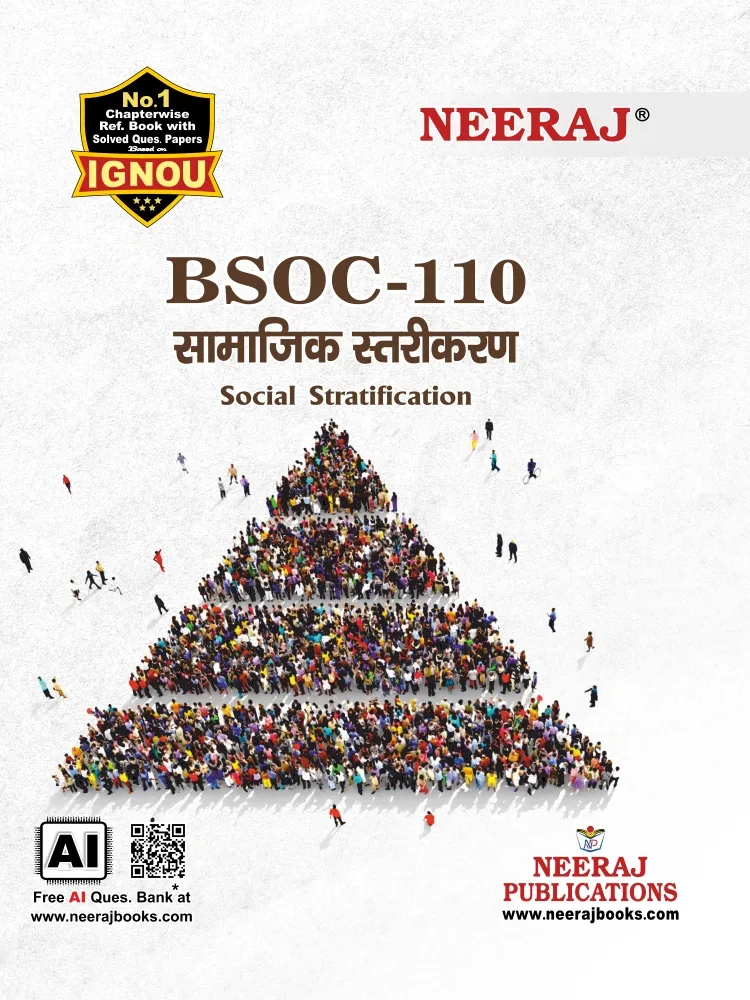
IGNOU BOOK | Social Stratification [Hindi medium] BSOC-110
सामाजिक स्तरीकरण (Social Stratification) — BSOC-110सामाजिक स्तरीकरण का अर्थ समाज में व्यक्तियों और समूहों का ऊँचे-नीचे सामाजिक स्तरों (स्तरों/परतों) में विभाजन है। यह विभाजन धन, शक्ति, प्रतिष्ठा, जाति, वर्ग, लिंग, शिक्षा आदि के आधार पर हो सकता है। इसमें समाज के कुछ लोगों को अधिक अवसर और संसाधन मिलते हैं, जबकि कुछ लोग उनसे वंचित रह जाते हैं।सरल शब्दों में: समाज में लोगों की सामाजिक स्थिति समान न होकर विभिन्न स्तरों में बँटी होती है, इसे सामाजिक स्तरीकरण कहते हैं।सामाजिक स्तरीकरण की प्रमुख विशेषताएँसामाजिक प्रकृति — यह समाज द्वारा निर्मित व्यवस्था है।पदानुक्रम (Hierarchy) — इसमें कुछ समूह ऊँचे और कुछ नीचे माने जाते हैं।असमानता — संसाधनों, अवसरों और अधिकारों का समान वितरण नहीं होता।सर्वव्यापकता — लगभग हर समाज में किसी न किसी रूप में स्तरीकरण पाया जाता है।स्थायित्व और परिवर्तनशीलता — कुछ व्यवस्थाएँ लंबे समय तक बनी रहती हैं, लेकिन सामाजिक परिवर्तन के साथ उनमें बदलाव भी आता है।सामाजिक गतिशीलता — विशेषकर वर्ग-आधारित व्यवस्था में व्यक्ति एक सामाजिक स्तर से दूसरे स्तर पर जा सकता है।सामाजिक स्तरीकरण के प्रमुख आधारजाति (Caste)वर्ग (Class)लिंग (Gender)आय और संपत्तिशक्ति और राजनीतिक प्रभावशिक्षा और व्यवसायसामाजिक प्रतिष्ठासामाजिक स्तरीकरण के उदाहरणभारत में जाति व्यवस्था सामाजिक स्तरीकरण का एक प्रमुख उदाहरण है। इसी प्रकार आर्थिक स्थिति के आधार पर उच्च वर्ग, मध्यम वर्ग और निम्न वर्ग का विभाजन भी स्तरीकरण को दर्शाता है।निष्कर्षसामाजिक स्तरीकरण समाज में असमानता और सामाजिक पदानुक्रम को समझने की महत्वपूर्ण अवधारणा है। समाजशास्त्र में इसके माध्यम से यह अध्ययन किया जाता है कि संसाधन, शक्ति, प्रतिष्ठा और अवसर विभिन्न सामाजिक समूहों में किस प्रकार वितरित होते हैं।
IGNOU BOOK | Social Stratification[English medium] BSOC-110
Social stratification refers to the structured and hierarchical division of society into different social groups or layers. These groups differ from one another in terms of wealth, income, power, prestige, status, education and access to social opportunities.In simple words, social stratification means the systematic pattern of social inequality in which some individuals or groups enjoy greater resources, privileges and power than others.Meaning of Social StratificationThe term ‘stratification’ comes from the idea of different layers or strata. Just as geological layers are arranged one above another, society is also divided into different social levels.Social stratification is therefore not simply an individual difference. It is a socially organised system of inequality that influences people's life chances, social relationships and opportunities.Major Characteristics of Social Stratification1. Social InequalitySocial stratification involves unequal distribution of wealth, income, power, prestige and opportunities among different groups.2. Hierarchical ArrangementPeople and groups are arranged in a hierarchy, with some occupying higher social positions and others occupying lower positions.3. Social NatureStratification is created and maintained by social institutions, norms, values and historical processes. It is not based only on individual abilities.4. PersistenceSocial inequalities can continue for long periods and may be transmitted from one generation to another.5. UniversalitySome form of social stratification exists in almost every society, although its nature and intensity vary from one society to another.6. Linked with Power and PrivilegePeople occupying higher positions generally have greater access to resources, decision-making power and social privileges.Forms of Social Stratification1. CasteCaste is a major form of social stratification, particularly associated with Indian society. Traditionally, caste membership is ascribed by birth. Caste has historically influenced occupation, marriage, social interaction and status.2. ClassClass is mainly associated with a person's economic position, including income, wealth, occupation and ownership of resources. Compared with caste, class systems generally provide greater opportunities for social mobility.3. GenderGender stratification refers to inequalities between different genders in areas such as education, employment, income, political participation, property ownership and access to resources.4. EstateThe estate system was characteristic of many feudal societies. People were divided into legally and socially distinct groups, such as the nobility, clergy and commoners. Each estate had different rights and privileges.
IGNOU BOOK | Social Startification[Hindi medium] BSOE-148
माजिक स्थिसामाजिक स्तरीकरण समाज में व्यक्तियों और समूहों का विभिन्न स्तरों या श्रेणियों में विभाजन है। इन स्तरों में लोगों की स्थिति समान नहीं होती। कुछ समूहों को अधिक धन, शक्ति, प्रतिष्ठा, सम्मान और अवसर प्राप्त होते हैं, जबकि कुछ समूह इन संसाधनों से वंचित रहते हैं।सरल शब्दों में, सामाजिक स्तरीकरण समाज में असमानता की एक व्यवस्थित और क्रमबद्ध व्यवस्था है।सामाजिक स्तरीकरण की प्रमुख विशेषताएँ1. सामाजिक असमानता:सामाजिक स्तरीकरण का आधार समाज में संसाधनों, शक्ति, प्रतिष्ठा और अवसरों का असमान वितरण है।2. पदानुक्रम:समाज के विभिन्न समूह ऊँचे और नीचे स्तरों में व्यवस्थित होते हैं।3. सामाजिक प्रकृति:स्तरीकरण केवल व्यक्तिगत क्षमताओं पर आधारित नहीं होता, बल्कि सामाजिक संस्थाओं, परंपराओं और नियमों से भी प्रभावित होता है।4. निरंतरता:असमानताएँ अक्सर लंबे समय तक बनी रहती हैं और कई बार एक पीढ़ी से दूसरी पीढ़ी तक पहुँचती हैं।5. सार्वभौमिकता:लगभग सभी समाजों में किसी न किसी रूप में सामाजिक स्तरीकरण पाया जाता है, हालांकि उसका स्वरूप अलग-अलग हो सकता है।6. शक्ति और विशेषाधिकार:ऊँचे सामाजिक स्तर पर स्थित लोगों को सामान्यतः अधिक शक्ति, प्रतिष्ठा और सुविधाएँ प्राप्त होती हैं।सामाजिक स्तरीकरण के प्रमुख रूप1. जाति व्यवस्थाजाति सामाजिक स्तरीकरण का एक प्रमुख रूप है, विशेष रूप से भारतीय समाज में। जाति की सदस्यता सामान्यतः जन्म पर आधारित होती है। पारंपरिक जाति व्यवस्था में व्यवसाय, विवाह, सामाजिक संबंध और सामाजिक प्रतिष्ठा जाति से जुड़े हुए थे।2. वर्ग व्यवस्थावर्ग व्यवस्था मुख्य रूप से आय, संपत्ति, व्यवसाय और आर्थिक स्थिति पर आधारित होती है। जाति की तुलना में वर्ग व्यवस्था में सामाजिक गतिशीलता की अधिक संभावना होती है। व्यक्ति अपनी शिक्षा, व्यवसाय और आर्थिक उपलब्धियों के आधार पर अपनी वर्ग स्थिति बदल सकता है।3. लिंग आधारित स्तरीकरणसमाज में पुरुषों, महिलाओं और अन्य लैंगिक समूहों के बीच संसाधनों, अवसरों, शिक्षा, रोजगार, आय और राजनीतिक शक्ति का असमान वितरण लिंग स्तरीकरण कहलाता है।4. सामंती एस्टेट व्यवस्थासामंती समाजों में लोगों को अलग-अलग एस्टेट या सामाजिक वर्गों में विभाजित किया जाता था। उदाहरण के लिए, सामंत, पादरी और सामान्य लोग अलग-अलग सामाजिक स्थिति रखते थे। प्रत्येक समूह के अधिकार और विशेषाधिकार अलग थे।सामाजिक गतिशीलतासामाजिक गतिशीलता का अर्थ है व्यक्ति या समूह का एक सामाजिक स्तर से दूसरे सामाजिक स्तर में जाना।इसके प्रमुख प्रकार हैं:ऊर्ध्वगामी गतिशीलता: निम्न सामाजिक स्थिति से उच्च स्थिति की ओर जाना।अधोगामी गतिशीलता: उच्च स्थिति से निम्न स्थिति की ओर जाना।क्षैतिज गतिशीलता: समान स्तर की एक सामाजिक स्थिति से दूसरी स्थिति में जाना।अंतर-पीढ़ीगत गतिशीलता: माता-पिता और बच्चों की सामाजिक स्थिति में परिवर्तन।अंतःपीढ़ीगत गतिशीलता: व्यक्ति के अपने जीवनकाल में साति में परिवर्तन।
IGNOU BOOK | Social Startification[English medium] BSOE-148
Social Stratification – BSOE-148Meaning of Social StratificationSocial stratification refers to the structured and hierarchical arrangement of individuals and groups in society into different layers or strata based on factors such as class, caste, gender, occupation, income, power, status and prestige.In simple words, social stratification means that society is divided into groups that have unequal access to resources, opportunities, power and social privileges.Main CharacteristicsSocial inequality – Stratification involves unequal distribution of wealth, power, status and opportunities.Hierarchy – Social groups are placed in a higher or lower position relative to others.Socially created – Stratification is shaped by social institutions, norms and historical processes.Persistence over time – Inequalities often continue from one generation to another.Universal but variable – Some form of stratification exists in most societies, but its form differs across societies.Linked with power and privilege – Higher social positions generally provide greater access to resources and decision-making.Major Forms of Social Stratification1. CasteThe caste system is a traditional form of stratification, particularly associated with Indian society. Caste membership is generally ascribed by birth. Traditionally, caste has been associated with occupation, social status, marriage rules and restrictions on social interaction.2. ClassSocial class is primarily associated with economic position, occupation, income and ownership of resources. Unlike caste, class systems generally allow greater mobility between social positions.3. GenderGender stratification refers to inequalities between men, women and other gender groups in areas such as education, employment, income, political participation and access to resources.4. EstateIn feudal societies, people were divided into legally and socially distinct estates, such as the nobility, clergy and commoners. Rights and privileges were distributed unequally among these groups.Social MobilityAn important feature of some stratification systems is social mobility, which refers to movement from one social position to another.Upward mobility: Movement to a higher social position.Downward mobility: Movement to a lower position.Horizontal mobility: Movement between positions of roughly similar status.Intergenerational mobility: Change in social position between parents and children.Intragenerational mobility: Change in an individual's social position during their own lifetime.
IGNOU BOOK | Rethinking Development [Hindi medium] BSOG 173
‘Rethinking Development’ का अर्थ है विकास की पारंपरिक अवधारणा और उसके तरीकों पर दोबारा विचार करना। लंबे समय तक विकास को मुख्यतः आर्थिक वृद्धि, औद्योगीकरण, आधुनिक तकनीक और प्रति व्यक्ति आय में वृद्धि से जोड़ा गया। लेकिन समय के साथ यह स्पष्ट हुआ कि केवल आर्थिक वृद्धि से गरीबी, असमानता, बेरोजगारी, पर्यावरणीय संकट और सामाजिक वंचना जैसी समस्याएँ समाप्त नहीं होतीं।इसलिए विकास की नई सोच में निम्न पहलुओं पर जोर दिया जाता है:मानव-केंद्रित विकास — विकास का उद्देश्य केवल GDP बढ़ाना नहीं, बल्कि लोगों के जीवन की गुणवत्ता सुधारना होना चाहिए।सामाजिक न्याय — विकास का लाभ समाज के सभी वर्गों तक पहुँचना चाहिए, विशेषकर गरीब, महिलाएँ, आदिवासी और हाशिए के समूह।सतत विकास — वर्तमान पीढ़ी की आवश्यकताओं को पूरा करते हुए प्राकृतिक संसाधनों और भविष्य की पीढ़ियों के हितों की रक्षा करना।समानता और भागीदारी — विकास की प्रक्रिया में स्थानीय समुदायों और आम लोगों की भागीदारी आवश्यक है।वैकल्पिक विकास मॉडल — पश्चिमी औद्योगिक मॉडल को हर समाज के लिए उपयुक्त मानने के बजाय स्थानीय परिस्थितियों, संस्कृति और जरूरतों को महत्व देना।विकास की आलोचना — यह भी देखा जाता है कि बड़े बाँध, खनन, औद्योगीकरण और शहरीकरण जैसी परियोजनाएँ किस प्रकार विस्थापन और पर्यावरणीय नुकसान पैदा कर सकती हैं।निष्कर्षइस प्रकार, विकास को केवल आर्थिक वृद्धि के रूप में देखने के बजाय उसे मानव कल्याण, सामाजिक न्याय, समानता, पर्यावरण संरक्षण और लोकतांत्रिक भागीदारी से जोड़ना ही ‘Rethinking Development’ का मूल विचार है। विकास का वास्तविक लक्ष्य ऐसा समाज बनाना होना चाहिए जिसमें लोगों को सम्मानजनक और बेहतर जीवन जीने के अवसर प्राप्त हों।
IGNOU BOOK | Rethinking Development[English medium] BSOG-173
Development is one of the central concepts in sociology and social sciences. Traditionally, development was understood mainly in terms of economic growth, industrialisation, modernisation, urbanisation and technological progress. A country was considered developed when its income, production and industrial capacity increased.However, this traditional understanding of development has been increasingly questioned. Economic growth alone does not necessarily eliminate poverty, inequality, unemployment, social exclusion or environmental degradation. This has led scholars to rethink the meaning, objectives and methods of development.Meaning of DevelopmentDevelopment can broadly be understood as a process of social, economic, political and cultural transformation that aims to improve people's quality of life.Traditional development approaches generally emphasised:Economic growthIndustrialisationModern technologyIncreased productionUrbanisationHigher per capita incomeThe newer understanding argues that development should also include human well-being, equality, freedom, social justice, participation and environmental sustainability.Why Rethink Development?There are several reasons for rethinking the conventional idea of development.1. Economic Growth Does Not Guarantee EqualityA country may experience rapid economic growth while large sections of its population continue to suffer from poverty and deprivation. The benefits of growth may be concentrated among a small section of society.Therefore, development should be concerned not only with the size of the economy but also with how resources and opportunities are distributed.2. Persistence of PovertyDespite economic and technological progress, poverty remains a major social problem in many parts of the world. This demonstrates that economic growth alone cannot guarantee a decent standard of living for everyone.3. Environmental CrisisConventional development has often encouraged intensive exploitation of natural resources. Industrialisation, mining, deforestation and excessive consumption can lead to:PollutionClimate changeLoss of biodiversityDeforestationWater scarcityDepletion of natural resourcesThis has increased the importance of sustainable development.4. Displacement and MarginalisationLarge development projects such as dams, mines, industries and highways may displace local communities. Indigenous people, tribal communities and poor populations may lose their land, livelihood and cultural connections.Therefore, development needs to be assessed from the perspective of those who experience its negative consequences.
IGNOU BOOK | Religion and Society[Hindi medium] BSOE-145
BSOE-145: Religion and Society (धर्म और समाज) IGNOU का समाजशास्त्र विषय है। इसमें धर्म को केवल आस्था या पूजा के रूप में नहीं, बल्कि एक सामाजिक संस्था के रूप में समझाया जाता है और यह देखा जाता है कि धर्म का समाज, संस्कृति, सामाजिक संबंधों, असमानता और सामाजिक परिवर्तन से क्या संबंध है।सरल हिन्दी में मुख्य विषयधर्म का समाजशास्त्रीय अध्ययनधर्म का अर्थ और विशेषताएँधर्म एक सामाजिक संस्था के रूप मेंधर्म के सामाजिक कार्यधर्म के प्रमुख समाजशास्त्रीय दृष्टिकोणकार्ल मार्क्स — धर्म, विचारधारा और वर्गएमिल दुर्खीम — धर्म, पवित्र-अपवित्र और सामाजिक एकतामैक्स वेबर — धर्म, सामाजिक क्रिया और सामाजिक परिवर्तनधर्म और सामाजिक व्यवस्थाधर्म और सामाजिक एकीकरणधर्म तथा सामाजिक नियंत्रणधार्मिक मान्यताओं का सामाजिक जीवन पर प्रभावधर्म, जाति और समुदायधर्म और जाति का संबंधधार्मिक समुदाय और पहचानधर्म तथा सामाजिक असमानताधर्म और सामाजिक परिवर्तनधर्म सामाजिक परिवर्तन को कैसे प्रभावित करता हैआधुनिकीकरण और धर्मधर्मनिरपेक्षीकरण (Secularisation)समकालीन समाज में धर्मधार्मिक विविधता और बहुलवादसाम्प्रदायिकताधार्मिक कट्टरवाद/मौलिकतावादबदलती धार्मिक पहचान और प्रथाएँपरीक्षा के लिए महत्वपूर्ण विचारसमाजशास्त्रीमुख्य विचारएमिल दुर्खीमधर्म और सामाजिक एकतामैक्स वेबरधर्म और सामाजिक क्रिया/परिवर्तनकार्ल मार्क्सधर्म, वर्ग और विचारधारापीटर बर्जरधर्म और सामाजिक वास्तविकता
IGNOU BOOK | Religion and Society[English medium] BSOE-145
BSOE-145: Religion and Society is an IGNOU Sociology course that examines religion as a social institution and studies its relationship with society, culture, social structure, power, identity, and social change.Simple descriptionThe course helps you understand:Meaning and Sociological Study of ReligionWhat is religion?Religion as a social institution.Difference between religious and sociological approaches to religion.Classical Sociological PerspectivesÉmile Durkheim – religion, social solidarity, sacred and profane.Max Weber – religion, social action, authority and economic life.Karl Marx – religion, ideology and social inequality.Religion and SocietyRelationship between religion and social structure.Religion's role in maintaining social order and social integration.Religion and social control.Religion, Caste and CommunityReligion and caste relations.Religious identities and communities.Issues of inequality and social stratification.Religion and Social ChangeHow religion can support as well as resist social change.Secularisation, modernisation and religious transformation.Religion in Contemporary SocietyReligious diversity and pluralism.Fundamentalism and communalism.Changing forms of religious practices and identities.
IGNOU BOOK | Reading Ethnographies[ Hindi medium] BSOE-144 |
Ethnography (नृवंशविज्ञान/नृजातिवृत्त) का अर्थ है किसी समाज या समुदाय के जीवन को करीब से जाकर, उनके दैनिक व्यवहार, संस्कृति, मान्यताओं, रिश्तों और अनुभवों को समझना और उसका विस्तृत वर्णन करना।BSOE-144 में मुख्य रूप से यह समझने पर जोर दिया जाता है कि:Ethnography क्या है?इसका अर्थ, प्रकृति और विशेषताएँ।मानव समाज के अध्ययन में इसका महत्व।Fieldwork (क्षेत्रकार्य)शोधकर्ता समुदाय के बीच जाकर जानकारी कैसे एकत्र करता है।Participant Observation (सहभागी अवलोकन) की भूमिका।Ethnographic Readingकिसी ethnography को केवल कहानी की तरह नहीं, बल्कि सामाजिक और समाजशास्त्रीय दृष्टि से पढ़ना।लेखक ने समाज का वर्णन किस दृष्टिकोण से किया है, यह समझना।Culture और Society का अध्ययनरीति-रिवाज, परंपराएँ, विश्वास, सामाजिक संबंध और रोजमर्रा का जीवन।अलग-अलग समुदायों की सामाजिक संरचना को समझना।Researcher और Community का संबंधशोधकर्ता और अध्ययन किए जा रहे लोगों के बीच संबंध।शोध में objectivity, subjectivity और reflexivity जैसे मुद्दे।Ethics (नैतिकता)शोध में लोगों की निजता और सम्मान की रक्षा।जानकारी का सही और जिम्मेदार उपयोग।
IGNOU BOOK | Introduction to Urban Sociology[Hindi medium] MSOE-105 |
नगरीय समाजशास्त्र समाजशास्त्र की एक महत्वपूर्ण शाखा है, जो शहरों, नगरीय जीवन, नगरीकरण और नगरीय समाज में होने वाले सामाजिक संबंधों एवं परिवर्तनों का अध्ययन करती है। यह समझने का प्रयास करती है कि शहरों के विकास से लोगों के जीवन, परिवार, समुदाय, व्यवसाय, संस्कृति और सामाजिक संबंधों में किस प्रकार परिवर्तन आता है।आधुनिक समय में नगरीकरण तेजी से बढ़ रहा है। इसलिए नगरीय समाजशास्त्र का महत्व भी लगातार बढ़ रहा है।नगरीय समाजशास्त्र का अर्थ‘नगरीय समाजशास्त्र’ दो शब्दों से मिलकर बना है— नगरीय और समाजशास्त्र।नगरीय का संबंध शहर या नगर से है।समाजशास्त्र समाज, सामाजिक संबंधों और सामाजिक प्रक्रियाओं का वैज्ञानिक अध्ययन है।अतः नगरीय समाजशास्त्र का अर्थ है नगरीय समाज, नगरीय जीवन, सामाजिक संस्थाओं, सामाजिक संबंधों और नगरीकरण की प्रक्रियाओं का समाजशास्त्रीय अध्ययन।यह केवल शहरों की जनसंख्या या भौगोलिक संरचना का अध्ययन नहीं करता, बल्कि यह देखता है कि शहर में रहने से लोगों के सामाजिक व्यवहार और जीवन-शैली पर क्या प्रभाव पड़ता है।नगरीय समाजशास्त्र के अध्ययन के प्रमुख क्षेत्र1. नगरीकरणनगरीकरण वह प्रक्रिया है जिसके द्वारा जनसंख्या और आर्थिक गतिविधियाँ ग्रामीण क्षेत्रों से शहरों की ओर बढ़ती हैं तथा समाज में नगरीय जीवन-शैली का विस्तार होता है।नगरीकरण के कारण रोजगार, शिक्षा, स्वास्थ्य और अन्य सुविधाओं के अवसर बढ़ सकते हैं, लेकिन इसके साथ आवास की कमी, यातायात, प्रदूषण और असमानता जैसी समस्याएँ भी उत्पन्न हो सकती हैं।2. नगरीय समुदायनगरीय समाजशास्त्र शहर में रहने वाले विभिन्न समुदायों का अध्ययन करता है। शहरों में अलग-अलग जाति, वर्ग, धर्म, भाषा और सांस्कृतिक पृष्ठभूमि के लोग रहते हैं।3. सामाजिक संबंधग्रामीण समाज की तुलना में शहरों में सामाजिक संबंध अक्सर अधिक औपचारिक, विविध और व्यक्तिगत हितों पर आधारित हो सकते हैं। व्यक्ति अनेक प्रकार के संगठनों और संस्थाओं से जुड़ा होता है।4. परिवार और विवाहनगरीकरण का प्रभाव परिवार और विवाह संस्थाओं पर भी पड़ता है। शहरों में एकल परिवार, महिलाओं की रोजगार में भागीदारी, विवाह की बदलती आयु और परिवार के आकार में परिवर्तन जैसी प्रवृत्तियाँ देखी जाती हैं।5. सामाजिक असमानताशहर आर्थिक अवसरों के साथ-साथ असमानता का भी केंद्र होते हैं। एक ही शहर में उच्च आय वाले क्षेत्रों के साथ-साथ झुग्गी-बस्तियाँ और गरीब बस्तियाँ भी हो सकती हैं।6. प्रवासग्रामीण से नगरीय क्षेत्रों की ओर प्रवास नगरीकरण का एक महत्वपूर्ण हिस्सा है। लोग रोजगार, शिक्षा, बेहतर जीवन और अन्य सुविधाओं की तलाश में शहरों की ओर आते हैं।7. नगरीय समस्याएँनगरीय समाजशास्त्र शहरों की विभिन्न सामाजिक समस्याओं का अध्ययन करता है, जैसे:आवास की समस्याझुग्गी-बस्तियों का विस्तारबेरोजगारीगरीबीयातायात की समस्याप्रदूषणअपराधसामाजिक अलगावकचरा प्रबंधन
IGNOU BOOK | Introduction to Urban Sociology[English medium] MSOE-105 |
Urban Sociology is the branch of sociology that studies cities, urban life, urban communities, social relationships, institutions, and problems associated with urbanization. It examines how people live and interact in cities and how urban environments influence society.1. Meaning of Urban SociologyThe word urban refers to cities and towns, while sociology is the systematic study of society and social relationships. Therefore, urban sociology can be understood as:The systematic study of urban society, urban social relationships, institutions, communities, and processes of urban development and change.Urban sociology studies not only the physical growth of cities but also changes in people's family life, occupations, culture, social relationships, class structure and lifestyles.2. Emergence of Urban SociologyUrban sociology developed mainly with the growth of modern cities during industrialization and urbanization. The Industrial Revolution led to the rapid expansion of cities because large numbers of people moved from rural areas to urban centres in search of employment.Early sociologists became interested in questions such as:Why do people migrate to cities?How does city life affect family and community relationships?Why do poverty and inequality exist in cities?How are different social groups distributed across urban space?How does industrialization change traditional social relationships?The Chicago School of Sociology played an important role in establishing urban sociology as a distinct field of study. Scholars such as Robert E. Park, Ernest W. Burgess and Louis Wirth studied urban communities, migration, neighbourhoods and urban lifestyles.3. Major Areas of StudyUrban sociology covers a wide range of subjects:a. UrbanizationIt studies the process through which an increasing proportion of the population lives in towns and cities.b. Urbanization and migrationIt examines rural-to-urban migration, migrant communities and the social consequences of migration.c. Urban communitiesIt studies neighbourhoods, slums, residential communities and relationships among urban residents.d. Social stratificationCities contain people belonging to different economic and social classes. Urban sociology studies inequality, poverty and social mobility.e. Family and social relationshipsUrban life can transform traditional family structures, kinship relations and patterns of social interaction.f. Urban cultureCities are often characterized by cultural diversity, new lifestyles, individualism, consumerism and changing values.g. Urban problemsUrban sociology examines problems such as unemployment, housing shortages, overcrowding, slums, crime, pollution, traffic congestion and inadequate public services.
IGNOU BOOK | Reading Ethnographies |ENGLISH MEDIUM | BSOC - 144 |
it is a Sociology course/book focused on understanding ethnography as a method of studying people, cultures, communities, and everyday social life.BSOC-144 — Reading Ethnographies: overviewThe book generally helps students learn how to read and interpret ethnographic studies, rather than simply memorize sociological theories.Key areas include:Meaning of ethnographyWhat ethnography isHow ethnographers study social and cultural lifeDifference between ethnography and other sociological methodsFieldwork and participant observationEntering the fieldBuilding relationships with participantsObservation, interaction, and recording field experiencesReading ethnographic textsUnderstanding the author's argumentsIdentifying concepts, evidence, and interpretationsConnecting individual experiences with wider social structuresCulture and everyday lifeCustoms, beliefs, practices, identities, and social relationshipsHow ordinary activities can reveal larger social processesPower, identity and inequalityCaste, class, gender, ethnicity and other forms of social differenceHow power operates in communities and institutionsEthics in ethnographic researchConsent and confidentialityThe researcher's relationship with participantsRepresentation of people and communitiesWriting ethnographyHow field observations become an ethnographic accountThe role of the researcher's perspectiveProblems of interpretation and representationIn simple wordsBSOC-144 teaches you how to understand society through detailed accounts of people's real-life experiences. Instead of looking only at statistics or abstract theories, ethnography examines how people actually live, interact, think, work, and make sense of their world.
IGNOU BOOK | Political Sociology | RAJNETIK SAMAJSASTR | BSOC - 105 | HINDI MEDIUM |
Political Sociology is a branch of sociology that studies the relationship between society and politics. It examines how power, authority, the state, political institutions, social groups, and citizens interact. It also studies how social factors such as class, caste, gender, religion, ethnicity, and social movements influence political behavior and decision-making.
IGNOU BOOK | Political Sociology | BSOC 105 | ENGLISH MEDIUM|
BSOC-105: Political Sociology is an IGNOU Sociology course that examines the relationship between society, power, politics, and the state.📘 BSOC-105 — Political SociologyThe book helps students understand how political institutions and processes are influenced by social structures, and how political power affects society.Major topics covered include:Political SociologyMeaning, nature and scopeRelationship between sociology and politicsPolitical power and authorityPower and AuthorityConcept of powerTypes of authorityMax Weber's ideas on power and authorityState and SocietyMeaning and functions of the stateRelationship between state and societyState, citizenship and political institutionsPolitical ParticipationVoting and electionsPolitical partiesPressure groups and movementsPolitical participation of different social groupsPolitical SocialisationHow people develop political attitudes and valuesRole of family, education, media and other institutionsSocial MovementsNature and types of movementsRelationship between social change and political actionCaste, Class and PoliticsInfluence of caste and class on political processesIdentity and representation in Indian politicsGender and PoliticsWomen's political participationRepresentation and political inequality📝 In simple wordsBSOC-105 explains how power operates in society and how social factors such as caste, class, gender, religion, identity and social movements influence politics. It also examines how political institutions and decisions, in turn, shape people's social lives.
IGNOU BOOK | Methods of Sociological Enquiry | SAMAJIK SASTR JACH KI VIDIYA | HINDI MEDIUM | BSOC -134
indira Gandhi National Open University का BSOC-134 समाजशास्त्र में शोध करने की विधियों और प्रक्रियाओं से संबंधित पाठ्यक्रम है। इसमें बताया जाता है कि समाज का वैज्ञानिक एवं व्यवस्थित अध्ययन कैसे किया जाता है।मुख्य विषयसमाजशास्त्रीय जाँच का अर्थसमाजशास्त्रीय शोध क्या है?शोध की प्रकृति और उद्देश्यसमाज के अध्ययन में वैज्ञानिक दृष्टिकोणशोध प्रक्रियाशोध समस्या का चयनउद्देश्य निर्धारित करनाशोध प्रश्न और परिकल्पनाशोध की योजना बनानाशोध अभिकल्प और नमूना चयनशोध अभिकल्प (Research Design)जनसंख्या और नमूनाविभिन्न प्रकार की Sampling विधियाँआँकड़ों का संकलनअवलोकनसाक्षात्कारप्रश्नावलीअनुसूचीकेस स्टडीमात्रात्मक और गुणात्मक विधियाँQuantitative ResearchQualitative Researchदोनों विधियों के बीच अंतरआँकड़ों का विश्लेषणप्राप्त जानकारी को व्यवस्थित करनावर्गीकरण और व्याख्यानिष्कर्ष निकालनाशोध में नैतिकताशोध प्रतिभागियों की सहमतिगोपनीयताशोधकर्ता की जिम्मेदारियाँनिष्पक्षता और ईमानदारीआसान भाषा मेंBSOC-134 हमें सिखाता है कि समाज से संबंधित किसी प्रश्न का व्यवस्थित तरीके से अध्ययन कैसे किया जाए—समस्या चुनने से लेकर जानकारी एकत्र करने, उसका विश्लेषण करने और निष्कर्ष प्रस्तुत करने तक।